Think about the most successful companies in the world today. You likely think of giants like Apple, Amazon, or Walmart. These are the titans of the industry, and they occupy a massive space in most people’s investment portfolios. But have you ever wondered where these giants came from? They didn’t start as trillion-dollar behemoths. Once upon a time, they were small, scrappy businesses operating out of garages or single storefronts. This brings us to a concept that many seasoned investors use to boost their long-term results: the small-cap tilt.
Adding a small-cap tilt to your portfolio doesn’t mean you are gambling on “penny stocks” or looking for the next “meme stock.” Instead, it is a deliberate, evidence-based strategy to give a slightly larger weight to smaller, publicly traded companies than the standard market index would normally give them. For a beginner, this might sound like extra work, but the logic behind it is surprisingly simple and deeply rooted in how markets have behaved for nearly a century.

In this guide, we are going to break down exactly what a small-cap tilt is, why it matters for your retirement, and how you can think about it without getting lost in complex math or Wall Street jargon. If you are looking to build a “set it and forget it” portfolio that still has some extra “oomph” for growth, understanding this strategy is a great place to start.
Understanding the Basics: What is Market Capitalization?
Before we can “tilt” anything, we need to understand what we are tilting. In the world of investing, companies are usually grouped by their size, which we call “Market Capitalization” or “Market Cap.”
You can figure out a company’s size by looking at two things: the price of one share and the total number of shares available to the public. If you multiply those two numbers, you get the total value of the company.
- Large-Cap Companies: These are the household names. Usually, these companies have a total value of 10 billion dollars or much more. Think of them as the massive cruise ships of the ocean—stable, hard to sink, but slow to turn and slow to double in size.
- Small-Cap Companies: These are smaller players, typically valued between 300 million dollars and 2 billion dollars. If large-caps are cruise ships, small-caps are nimble speedboats. They can move much faster, but they also feel the waves a lot more.
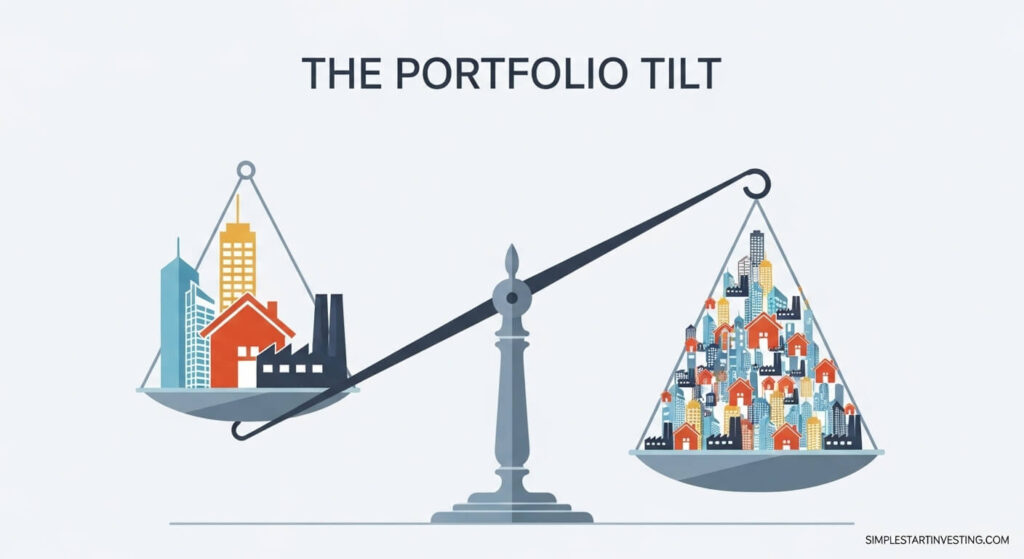
A standard total market index fund (like one that tracks the S&P 500) is “market-cap weighted.” This means the bigger the company, the more of your money goes into it. If Apple makes up 7 percent of the market, then 7 dollars of every 100 dollars you invest goes to Apple. A small-cap tilt is simply the decision to take a little bit of that money and move it toward the smaller “speedboats” of the economy.
Why the “Size Factor” Matters for Your Money
You might be asking, “Why would I want to own smaller, riskier companies when I can just own the big, safe ones?” The answer lies in what researchers call the “size premium.”
Historically, over very long periods of time—we are talking decades, not months—smaller companies have tended to outperform larger ones. The logic is fairly intuitive once you strip away the finance terms.
Imagine a company that is worth 1 billion dollars. For that company to double its value to 2 billion dollars, it needs to find a few successful new products or expand into a few new regions. Now, imagine a company like Microsoft, which is worth trillions. For Microsoft to double in size, it would almost have to take over the entire global economy. It is simply much harder for a giant to grow at a high percentage rate than it is for a small, efficient company.
By applying a small-cap tilt, you are essentially placing a small side bet that these smaller companies will continue their historical trend of higher growth. You aren’t replacing your “safe” large companies; you are just leaning the scale a bit more in favor of the little guys to capture that potential extra return.
Common Misconceptions About Small-Cap Tilting
When beginners hear about focusing on small companies, their minds often go to the wrong places. Let’s clear up some of the most common myths that keep people from using a small-cap tilt effectively.

Myth 1: Small-Cap Means “Penny Stocks”
This is perhaps the most dangerous misunderstanding. Penny stocks are often tiny, unregulated companies that trade for cents and are prone to scams. The small-cap stocks we are talking about are legitimate, publicly traded companies listed on major exchanges like the New York Stock Exchange or NASDAQ. They have real products, real employees, and real revenue. They are just “small” compared to giants like Google.
Myth 2: It’s All or Nothing
Many beginners think they have to choose between a “safe” portfolio and a “small-cap” portfolio. This isn’t true. A small-cap tilt is usually just a small adjustment. For example, if a standard portfolio naturally has 10 percent in small companies, a “tilted” portfolio might move that up to 20 percent. You still keep your core foundation of large, stable companies.
Myth 3: It’s a “Get Rich Quick” Scheme
Because small companies can grow quickly, people think they will see massive gains next week. In reality, the “size premium” can disappear for years—even a decade—at a time. Small-caps can underperform large-caps for a long stretch. This strategy is for the patient investor who is looking at a 20 or 30-year horizon for retirement.
The Reality of Volatility: What to Expect
If small-caps have the potential for higher returns, what is the catch? In the investing world, there is no such thing as a free lunch. The “price” you pay for that potential extra growth is volatility.

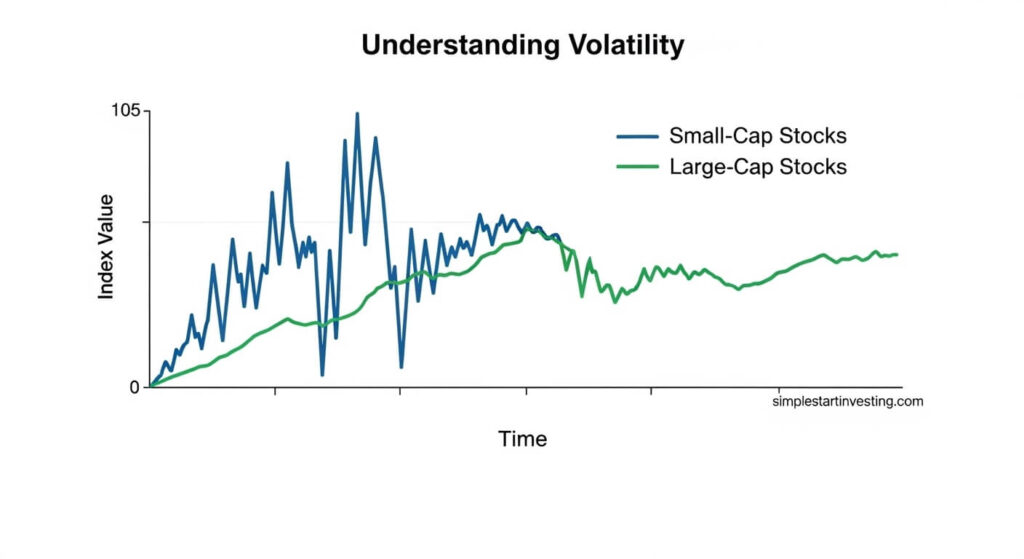
Volatility is a fancy word for how much the value of your investment bounces up and down. Small companies are more sensitive to the economy. If interest rates go up or there is a recession, a small company might struggle to get a loan, whereas a giant like Walmart has plenty of cash in the bank to weather the storm.
When you add a small-cap tilt to your strategy, you have to be prepared for your account balance to swing more wildly. If the market drops by 10 percent, your small-cap portion might drop by 15 or 20 percent. However, when the market recovers, those small companies often lead the way back up. If you are the type of person who panics when you see red numbers on your screen, a heavy tilt might not be for you. But if you can stay calm and keep your eyes on the long-term goal, the ride is often worth it.
The “Value” Twist: Why Small-Cap Value is Often Preferred
If you hang around investing forums long enough, you’ll hear people talk about “Small-Cap Value” specifically, rather than just “Small-Cap.” This is a slightly more advanced version of the small-cap tilt, but it’s worth understanding.
There are generally two types of small companies:
- Growth: Companies that are reinvesting everything to grow as fast as possible. They are often expensive to buy because everyone expects them to be the next big thing.
- Value: Companies that are currently “on sale.” Maybe they aren’t the trendiest businesses, but they are profitable and their stock price is low compared to their actual earnings.
Historically, the combination of “Small” and “Value” has been the “sweet spot” for many long-term investors. While small growth companies often spend too much money trying to expand and eventually fail, small value companies are often misunderstood gems that the market eventually realizes are worth more. When people talk about a small-cap tilt, they are very often referring to adding a Small-Cap Value index fund to their portfolio.
How to Implement a Simple Small-Cap Tilt
You don’t need to be a math genius or a professional trader to do this. In fact, the simpler you keep it, the better. Here is how most everyday investors at simplestartinvesting.com think about it.
Most people start with a “Total Stock Market” index fund. This fund already owns almost every public company in the US. However, because it is weighted by size, about 80 percent of your money is in large companies, and only a tiny fraction is in the smallest ones.
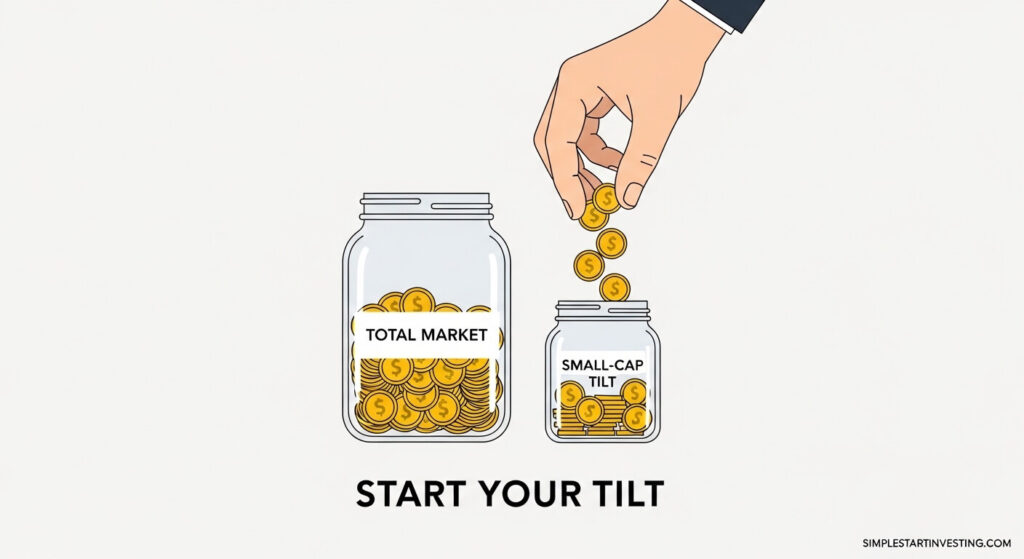
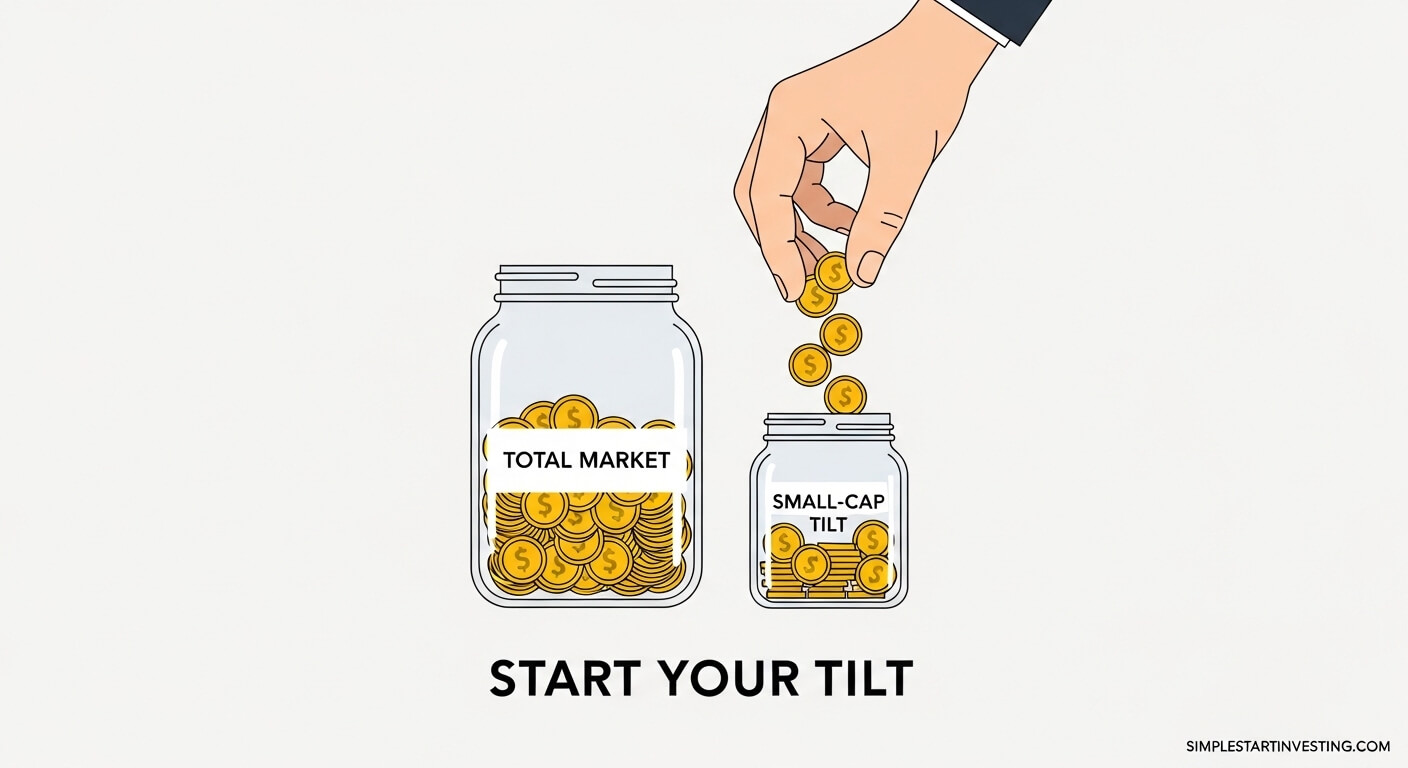
To create a small-cap tilt, you simply buy a second fund—a Small-Cap Index Fund or a Small-Cap Value Index Fund.
Let’s look at a simple example. Suppose you have 1,000 dollars to invest.
- In a Standard Strategy, you might put all 1,000 dollars into a Total Stock Market Fund. You now own the whole market, but you are heavily skewed toward the “Big Tech” giants.
- In a Tilted Strategy, you might put 800 dollars into that same Total Stock Market Fund and 200 dollars into a Small-Cap Value Fund.
By doing this, you have “tilted” your portfolio. You still own the whole market, but you’ve given yourself a 20 percent weight in those smaller, high-potential companies. You are still diversified, but you’ve adjusted the recipe to include a bit more “spice” for growth.
The Role of Diversification and Safety
One of the biggest mistakes beginners make is going “all in” on a single sector because they heard it has high returns. It is important to remember that a small-cap tilt is an addition to a diversified portfolio, not a replacement for it.
The beauty of using index funds for this strategy is that you aren’t picking one or two small companies. If you buy a Small-Cap Value ETF, you might be buying tiny pieces of 600 or even 2,000 different small companies. If ten of those companies go bankrupt, it barely affects you because the other hundreds of companies are still working for you.
This “safety in numbers” is what makes the small-cap tilt a viable strategy for a beginner. You get to capture the growth of the small-cap sector without the terrifying risk of losing everything because one specific business failed.
Tax Considerations and Retirement Accounts
In the United States, where you hold your investments matters just as much as what you buy. If you are using a small-cap tilt, you should think about whether you are doing this in a retirement account (like a 401k or an IRA) or a regular brokerage account.
Small-cap funds can sometimes be less “tax-efficient” than large-cap funds. This is because smaller companies might be bought out by bigger ones, or they might grow so fast that the fund has to sell them to stay within its “small-cap” rules. These sales can trigger taxes if they happen in a regular account.
For many beginners, it makes sense to keep the “tilted” portion of their portfolio inside a tax-advantaged account like a Roth IRA. In a Roth IRA, your investments grow tax-free, so you don’t have to worry about the IRS taking a cut every time the fund rebalances or a small company hits a home run.
When Should You NOT Use a Small-Cap Tilt?
While we love the logic of this strategy, it isn’t for everyone. You might want to stick to a standard, non-tilted strategy if:
- You are very close to retirement: If you need your money in the next two or three years, you don’t have time to wait out the periods where small-caps underperform.
- You have a low risk tolerance: If seeing your portfolio drop 20 percent in a month would make you lose sleep or sell everything in a panic, keep it simple with large-caps.
- You want the absolute simplest path: There is absolutely nothing wrong with just owning one Total Market Fund. It is a fantastic way to build wealth. The small-cap tilt is an “extra” step for those who want to optimize, but it is not a requirement for success.
The Psychology of Staying the Course
The hardest part of a small-cap tilt isn’t the math—it’s the psychology. There will be years where the S&P 500 (the big companies) is up 15 percent, and your small-cap funds are down 5 percent. Your friends will brag about their gains in big-name stocks, and you will feel like you are “losing.”
This is where most people fail. They abandon the tilt right before it starts to work. To succeed with this strategy, you have to realize that you are intentionally being “different” from the market. Being different means that sometimes you will do much better, and sometimes you will do worse. The “premium” only comes to those who stay the line for decades.
Final Thoughts for the Beginner Investor
The small-cap tilt is one of the most accessible “pro” moves a beginner can make. It doesn’t require you to read balance sheets or time the market. It only requires you to have a basic understanding of why smaller companies have a higher ceiling for growth and the discipline to hold onto them through the inevitable ups and downs.
By leaning slightly away from the giants and toward the rising stars, you are giving your future self a chance at higher returns. Start small, stay diversified, and remember that time in the market is always more important than timing the market.
Disclaimer: This content is for educational purposes only and does not constitute financial advice. The financial markets and tax regulations are subject to change, and you should always perform your own due diligence or consult with a qualified professional before making investment decisions.