
Choosing your first home in the United States is one of the most exciting and overwhelming decisions you will ever make. It is not just about the number of bedrooms or the color of the kitchen cabinets. The type of property you choose—whether it is a condo, a townhouse, or a single-family home—will determine your monthly budget, your weekend chores, and even how much privacy you have when you drink your morning coffee.
Many first-time buyers start their search by looking at home property types through the lens of price alone. While the sticker price is important, it is only one piece of the puzzle. Each of these three options comes with a different set of rules, tax implications, and long-term costs that can catch a beginner off guard if they are not prepared.
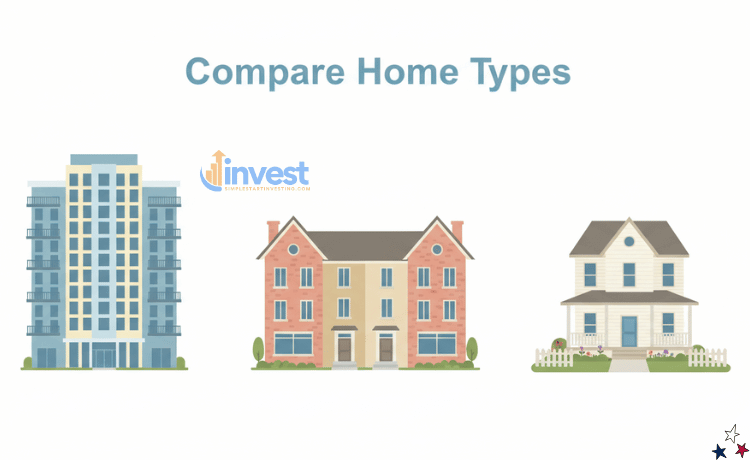
In this guide, we will break down the fundamental differences between these three property types. We will look at what you actually own, what you are responsible for fixing, and how your choice impacts your lifestyle. By the time you finish reading, you will have a much clearer picture of which home fits your current life and your future financial goals.
Understanding the Single-Family Home: The Standard of Independence
The single-family home is often considered the “gold standard” of the American Dream. Technically, this is a detached building that sits on its own piece of land. You do not share walls, ceilings, or floors with any neighbors. When you buy a single-family home, you are typically purchasing both the structure and the “dirt” it sits on.
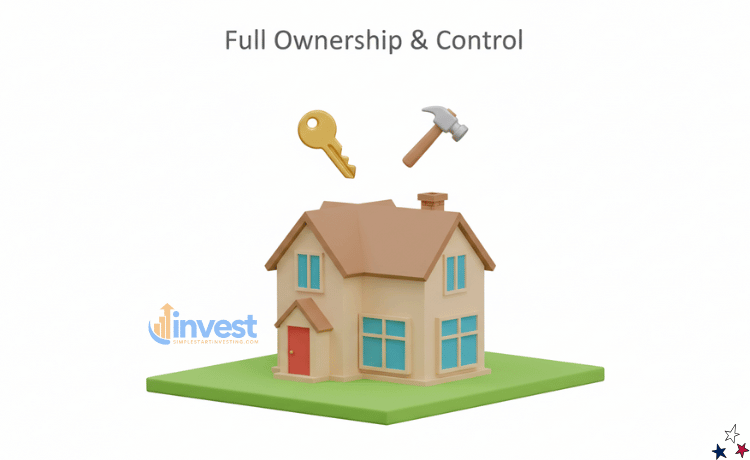
This property type offers the highest level of control. If you want to paint your front door bright purple or plant a massive vegetable garden in the backyard, you generally have the freedom to do so—unless you live in a neighborhood with a Homeowners Association (HOA). For many, the lack of shared walls is the biggest selling point because it provides a level of privacy that other property types simply cannot match.
Let’s look at a real-world example
Imagine you work for a major company like Walmart or Amazon in a suburban area like Bentonville, Arkansas, or outside of Nashville, Tennessee. You decide to buy a single-family home. Because you own the land, you decide to build a fence for your dog and add a deck for summer barbecues. You are responsible for mowing the grass every Saturday and paying for a new roof if it starts to leak. Your costs are entirely within your control, but so is the workload.
The common beginner misconception
Many new buyers believe that “owning” a single-family home means they have 100% freedom to do whatever they want. They assume that since it is a “house,” there are no extra fees or rules like those found in a condo building.
The correct financial mindset
The reality is that more than 30% of single-family homes in the U.S. are part of an HOA. Before you buy, you must check if the house is in a “planned community.” If it is, you might still have to pay a monthly fee (often between 200 dollars and 300 dollars) and follow strict rules about your landscaping or even what kind of curtains you can hang in your windows. Always verify the HOA status before assuming you have total independence.
What Exactly is a Condominium (Condo)?
A condominium, or “condo,” is a very different animal. When you buy a condo, you are usually only buying the “airspace” inside the walls of your unit. Think of it like owning a slice of a larger pie. You own the interior, but you share ownership of the “common areas” like the hallways, the elevators, the roof, and the parking garage with every other owner in the building.
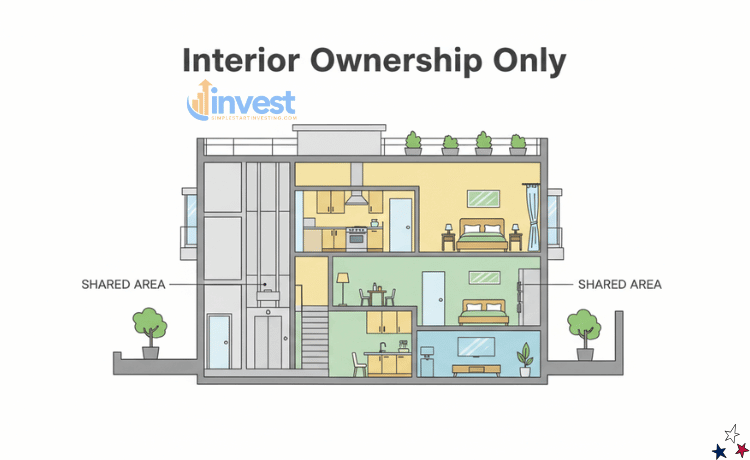
Condos are incredibly popular in high-density cities where land is expensive. If you are looking to live near a tech hub or a major financial district, a condo is often the most affordable entry point. The biggest advantage is the “lock-and-leave” lifestyle. You don’t have to worry about shoveling snow, fixing a communal pool, or painting the exterior of the building. The association handles all of that for you.
Let’s look at a real-world example
Consider a young professional working at Apple (AAPL) or Microsoft in a city like Seattle or Austin. They buy a 10th-floor condo to be close to the office. Every month, they pay their mortgage plus a 400 dollar condo fee. In exchange for that fee, they get access to a gym, a rooftop lounge, and a 24-hour security guard. When the building’s roof needs a repair, they don’t have to call a contractor; the condo association manages the project using the collective funds of all residents.
The common beginner misconception
Beginners often look at a condo’s lower purchase price and think it is “cheaper” than a house. They might see a condo for 300,000 dollars and a house for 400,000 dollars and assume they are saving 100,000 dollars.
The correct financial mindset
You must look at the “Total Monthly Carrying Cost.” While the condo mortgage might be lower, the monthly HOA fees can be significant. If a condo has a 500 dollar monthly fee, that is equivalent to roughly 70,000 dollars to 100,000 dollars in additional mortgage debt. Furthermore, if the building hasn’t saved enough money for big repairs, you might be hit with a “Special Assessment”—a one-time bill for thousands of dollars to fix something like an elevator. Always review the “HOA Reserves” before buying to ensure the building is financially healthy.
The Townhouse: The Middle Ground
If a single-family home is a steak and a condo is a salad, a townhouse is a hearty burger—it’s the perfect middle ground. A townhouse is a multi-level home that shares one or two walls with neighbors, but it usually has its own private entrance from the street. Unlike a condo, when you buy a townhouse, you typically own the structure and the small patch of land directly underneath it (and often a tiny front or back yard).
Townhouses offer more space than most condos, often including a private garage, but they are usually more affordable than detached houses. They are very common in suburban “master-planned” communities. You get the feeling of a “house” without the massive yard maintenance.
Let’s look at a real-world example
Imagine a family living in a suburb of Charlotte, North Carolina. They want more space than an apartment but aren’t ready to spend 500,000 dollars on a detached home. They find a three-story townhouse for 350,000 dollars. They share a wall with their neighbor, so they have to be a bit more careful about loud music. However, they have their own garage for their Tesla (TSLA) and a small patio for a grill. Their HOA fee is 150 dollars a month, which covers the community playground and lawn care for the front of the unit.
The common beginner misconception
Many people think a townhouse is just a “tall condo.” They assume the rules and ownership are exactly the same.
The correct financial mindset
The legal structure is key. In a townhouse, you are often responsible for your own roof and your own exterior painting. In a condo, the association usually covers the “shell” of the building. This means that while your monthly fees for a townhouse might be lower than a condo, you need to save your own “emergency fund” for exterior repairs. If your townhouse roof leaks, it’s on you to fix it, not the neighbors.
Comparing Maintenance Responsibilities
Maintenance is where your lifestyle really changes based on the home property types you choose. If you hate physical labor, a single-family home might feel like a second job. If you love “DIY” projects and home improvement, a condo might feel stifling and restrictive.
In a Single-Family Home, you are the “Chief Maintenance Officer.” If the HVAC system dies in the middle of a July heatwave, you are the one calling the repairman and writing the check for 5,000 dollars. You are also responsible for the “curb appeal”—the landscaping, the siding, and the driveway.
In a Condo, your maintenance responsibility stops at your “walls-in.” If a pipe bursts inside your kitchen wall, it is your problem. But if the main water line for the building breaks, the association handles it. This makes budgeting easier because many costs are “pooled” together into your monthly fee.
In a Townhouse, it varies wildly. Some townhouses operate like condos (where the association handles the roof), while others operate like houses (where you handle everything). You must read the “Covenants, Conditions, and Restrictions” (CC&Rs) very carefully during the buying process to see exactly where your responsibility ends and the association’s begins.
The Hidden Impact of HOA Fees on Your Budget
We cannot talk about home property types without diving deep into the math of Homeowners Associations. As of this year, nearly 80 million Americans live in HOA-governed communities. These fees are not optional; if you don’t pay them, the association can actually place a lien on your home or even foreclose on it.
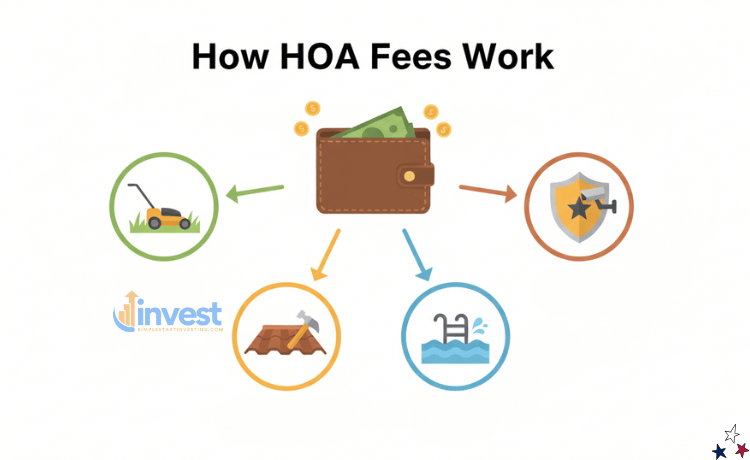
HOA fees are used for two things:
- Operating Expenses: Trash pickup, landscaping, pool chemicals, insurance for common areas, and electricity for hallways.
- Reserve Funds: Savings for major future projects like repaving the parking lot or replacing the roof in ten years.
How to calculate the “True Cost”
Let’s use a simple example. Suppose you are looking at two properties:
- Property A: A single-family home for 400,000 dollars with no HOA.
- Property B: A condo for 320,000 dollars with a 400 dollar monthly HOA fee.
On the surface, Property B looks 80,000 dollars cheaper. However, if you look at your monthly bank account, that 400 dollar fee is roughly the same as a monthly payment on a 60,000 dollar loan at current interest rates. When you add in the fact that the condo might appreciate (increase in value) slower than the house, the “cheaper” option might actually cost you more over ten years.
Why beginners get it wrong
New buyers often think of HOA fees as “wasted money.” They see it as a “tax” that doesn’t benefit them.
The correct financial mindset
Think of an HOA fee as “pre-paid maintenance.” If you live in a house and don’t pay an HOA, you still have to pay for a new roof, a new lawnmower, and a gym membership. In a condo, those costs are simply consolidated into one bill. The goal is to find an HOA that provides value. A 300 dollar fee that includes high-speed internet, water, and a great pool is a better deal than a 100 dollar fee that only covers a sign at the entrance of the neighborhood.
Privacy and Lifestyle: The “Shared Wall” Factor
Privacy is a luxury in real estate. It is often the primary reason people move from apartments to single-family homes. When choosing between these home property types, you have to be honest about how much you value silence and space.
- Single-Family Homes: You have the most privacy. You can have a loud dinner party or a crying baby, and the neighbors likely won’t hear a thing. You also have “horizontal distance” from others.
- Townhouses: You share side walls. Modern construction is good at soundproofing, but you might still hear a heavy-footed neighbor or a loud television. You also share the “driveway experience”—you’ll likely see your neighbors every time you get in your car.
- Condos: You have neighbors above, below, and on both sides. This is the highest level of “community” living. If someone is renovating their bathroom three floors up, you might hear the drilling.
The common beginner misconception
Many beginners assume that “higher price” always means “more privacy.”
The correct financial mindset
Privacy is a specific feature, not just a result of price. You can find a 1 million dollar condo in Manhattan with zero privacy from neighbors, or a 200,000 dollar cabin in the woods with total seclusion. When you tour a property, don’t just look at the view. Stay silent for a few minutes and listen to the building. Can you hear the elevator? Can you hear the neighbor’s dog? Your daily happiness depends on these small details.
Resale Value and Investment Potential
When you buy a home, you are also making an investment. Historically, different home property types appreciate at different rates.

Single-family homes generally appreciate the fastest. Why? Because you own the land. Land is a finite resource; they aren’t making any more of it. As the population grows, the land under a house becomes more valuable. Furthermore, single-family homes appeal to the largest pool of buyers (families, investors, retirees), which keeps demand high.
Townhouses are usually the second-fastest to grow in value. They are a “step-up” for apartment dwellers and a “downsize” for older homeowners. This “double-sided” demand makes them very stable investments.
Condos tend to appreciate more slowly. Since you don’t own the land, the value is tied strictly to the building’s condition and the local neighborhood’s popularity. If five other identical units in your building are for sale at the same time, you have a lot of competition, which can drive prices down.
Let’s look at a real-world example
Imagine a buyer in 2015 who bought a condo and a house in a growing city like Phoenix. Ten years later, the house might have doubled in value because developers can’t find any more land nearby. The condo might have only grown by 40%, because several new, shinier condo buildings were built just two blocks away, making the older building less “trendy.”
The common beginner misconception
“A home is a home; it will always go up in value.”
The correct financial mindset
Real estate is about supply and demand. If you buy a condo in a city where 2,000 new units are being built every year, your “supply” is high, which limits how much you can raise your price when you sell. If you buy a house in a neighborhood where no new houses can be built, your “supply” is fixed, which usually leads to higher price growth.
Tax Implications and Ownership Costs
The IRS treats these home property types very similarly, but there are nuances you should know. For all three, you can generally deduct your mortgage interest on the first 750,000 dollars of your mortgage debt (if you are married filing jointly). You can also deduct your state and local property taxes (up to a certain limit, currently 10,000 dollars total for the SALT deduction).
However, the “Assessed Value” for taxes can be different.
- Condos: Often have lower property taxes because you own less “real estate” (land).
- Single-Family Homes: Often have the highest property taxes because you own a large plot of land.
A note on insurance
Insurance is another area where costs diverge.
- Single-Family/Townhouse: You need a “Standard Homeowners Policy” (HO-3). This covers the whole structure and the land. It is usually more expensive.
- Condo: You need a “Walls-In” policy (HO-6). This is much cheaper because the main building insurance (covered by your HOA fees) handles the exterior. You only have to insure your personal belongings and the interior finishes.
Which Property Type is Right for You?
Choosing between a condo, townhouse, or single-family home isn’t about finding the “best” one—it’s about finding the best one for you right now.
- Choose a Single-Family Home if: You want maximum privacy, you enjoy gardening or yard work, you want the best long-term investment, and you have the budget for higher maintenance costs.
- Choose a Townhouse if: You want a balance of space and affordability, you don’t mind sharing a wall, and you want some community amenities without the high fees of a high-rise building.
- Choose a Condo if: You want a low-maintenance lifestyle, you want to live in a walkable urban center, you are a first-time buyer with a smaller down payment, and you value amenities like gyms and pools over private yards.
A final piece of advice: Before you sign any contract, always ask for the “HOA Meeting Minutes” from the last six months. These documents are like a “diary” for the building or neighborhood. They will tell you if the neighbors are fighting, if the roof is about to collapse, or if the association is planning to double the monthly fees next year.
The market can be complex, and rules regarding taxes or HOA regulations can change. It is always a smart move to consult with a local real estate agent and a tax professional to see how these choices impact your specific financial situation.
Disclaimer: This content is for educational purposes only and does not constitute financial, legal, or tax advice. Real estate laws and market conditions vary by location and are subject to change. Always consult with a qualified professional before making any real estate investment.