
Imagine you and nine of your friends decided to open a small lemonade stand in your neighborhood. At the end of a very hot summer day, your little business made a total profit of 100 dollars after paying for the lemons, sugar, and cups. Since there are ten of you who own this business equally, you naturally want to know how much of that profit belongs to each person. By dividing the 100 dollars by the 10 owners, you find that each person “earned” 10 dollars. In the massive world of the stock market, this simple calculation is exactly what professional investors call Earnings Per Share, or EPS.
Earnings Per Share is perhaps the most important number you will see when you look at a stock quote for a company like Nvidia or Apple. While the total profit of a multi-billion dollar corporation sounds impressive, it does not tell you much as an individual investor. You need to know how much of that profit is squeezed into the single share that you hold in your brokerage account. If a company makes billions but has trillions of shares, your individual “slice” of the profit might actually be tiny.
Understanding Earnings Per Share is the first step toward moving from a “gambler” mindset to an “owner” mindset. When you buy a stock, you are buying a portion of that company’s future earnings. EPS is the direct measurement of those earnings. In this guide, we will break down why Wall Street is obsessed with this number, how to read it without needing a math degree, and why a rising EPS is often the fuel that sends stock prices to the moon.
What Exactly Is Earnings Per Share?
At its most basic level, Earnings Per Share is a way to see how much profit a company generates for every single outstanding share of its stock. Think of it as the “bottom line” for the individual investor. If a company is a giant pie, the “Earnings” is the size of the whole pie, and the “Shares” are the number of slices the pie has been cut into. EPS tells you exactly how much filling is in your specific slice.
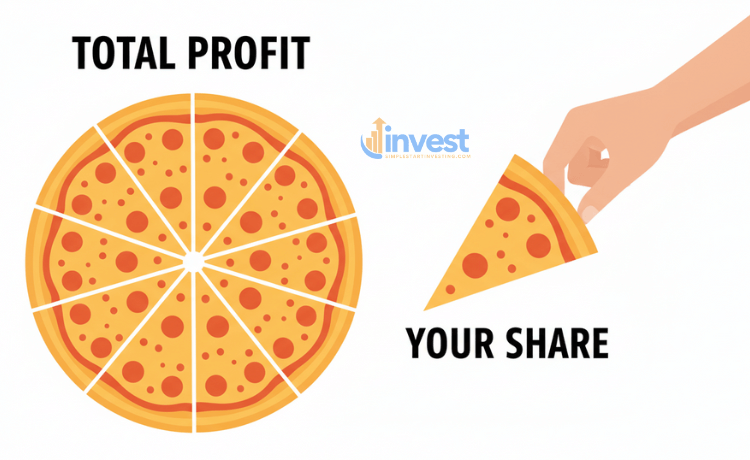
For example, let’s look at a major American retailer like Walmart. If Walmart makes a massive amount of money in a three-month period, they don’t just keep that number as one giant lump sum. They have millions of investors holding their stock. To make it fair and easy to understand, they report how much of that profit applies to one share. If the EPS is 2 dollars, and you own 10 shares, your “portion” of the company’s profit for that period is 20 dollars.
Many beginners make the mistake of looking only at the total revenue of a company. They see a headline saying “Amazon Makes Billions” and assume the stock must be a great buy. However, revenue is just the money coming in the front door. Earnings Per Share is the money that stays in the company’s pocket after every bill, tax, and employee has been paid. It is the pure profit that actually belongs to the shareholders.
The mindset shift here is crucial. You should stop looking at a company as a “ticker symbol” that goes up and down and start looking at it as a “profit-generating machine.” When you look at Earnings Per Share, you are asking: “How efficient is this machine at creating wealth for me, the owner?”
How to Calculate EPS (The Simple Way)
You do not need to be a math genius or use a complex calculator to understand how Earnings Per Share is found. It is a simple process of division that you can do in your head or with a basic smartphone app. To find the EPS, you take the total net income of the company and divide it by the number of shares that people are currently holding.
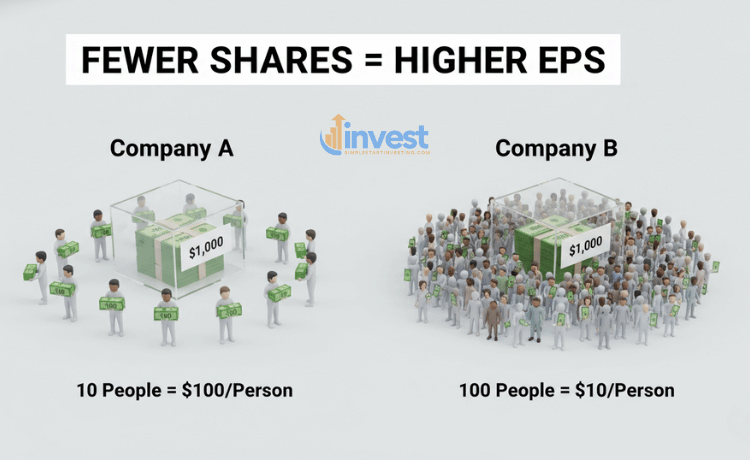
Let’s use a hypothetical example with a tech giant like Apple (AAPL). Suppose Apple makes a total net profit of 1,000 dollars in a year. If Apple has 100 shares of stock held by investors, you simply divide the 1,000 dollars by those 100 shares. The result is 10 dollars. This 10 dollars is the Earnings Per Share. It represents the amount of money Apple earned for every single share of its stock during that year.
Now, why does this matter? Imagine if Apple made the same 1,000 dollars in profit, but they had 500 shares of stock held by investors instead of 100. If you divide 1,000 dollars by 500 shares, the EPS drops to only 2 dollars per share. Even though the company made the same amount of total profit, your individual share is now much “poorer” because the profit is being spread across more people.
A common misunderstanding for beginners is thinking that a company with a high stock price must have a high EPS. This is not always true. A stock could cost 500 dollars per share but only have an EPS of 1 dollar, while another stock might cost 50 dollars and have an EPS of 5 dollars. The second company is actually generating more profit per share for its owners, even though its “price tag” is lower.
Instead of looking at the price, look at the productivity. A high Earnings Per Share relative to the price of the stock often suggests that the company is a powerhouse at making money. Your goal as an investor is to find companies that can consistently grow this number year after year.
Why Does Wall Street Care So Much About EPS?
If you have ever watched financial news like CNBC or read the Wall Street Journal, you have probably heard the phrase “Earnings Season.” This is a period four times a year when most public companies release their financial reports. During this time, analysts and investors focus almost entirely on whether a company met, exceeded, or fell short of its “EPS estimates.”
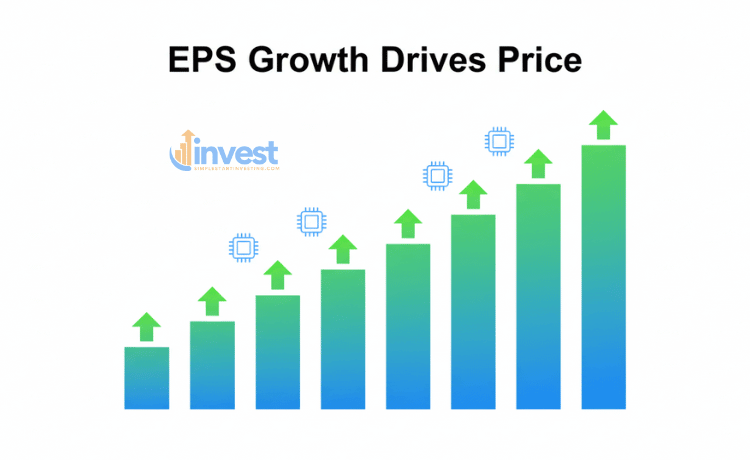
Take a company like Nvidia (NVDA). Because Nvidia is a leader in artificial intelligence chips, investors have very high expectations for them. If analysts predict that Nvidia will report an Earnings Per Share of 5 dollars, but the company actually reports 6 dollars, the stock price often shoots up. This is because the company proved it is more profitable than everyone expected. On the other hand, if they report 4 dollars, the stock might crash, even if 4 dollars is still a lot of money.
The reason for this obsession is that EPS is the engine that drives stock prices in the long run. In the short term, stock prices move based on news, rumors, and emotions. But over 5 or 10 years, a stock’s price almost always follows its Earnings Per Share. If a company consistently makes more profit for every share, that share becomes more valuable, and people will pay more to own it.
Beginners often get distracted by “hype” or “cool products.” They might buy a stock because they like the company’s new electric car or smartphone. However, if that cool product doesn’t eventually lead to a higher Earnings Per Share, the stock price will eventually stall or fall. The big institutions on Wall Street know this, which is why they use EPS as their primary yardstick for success.
The shift in mindset here is to treat “Earnings Day” like a report card. You aren’t just looking for a “passing grade.” You are looking for a company that is an “A+ student,” constantly figuring out ways to increase the profit attached to every share you own.
The Difference Between Basic EPS and Diluted EPS
When you look up a company’s financial data on a site like Yahoo Finance or your brokerage app, you might see two different numbers: Basic EPS and Diluted EPS. This can be confusing for a beginner, but the difference is actually very simple and very important for protecting your investment.
Basic EPS is the “best-case scenario” number. It calculates profit using only the shares that are currently being traded in the market right now. For example, if Amazon (AMZN) has 100 shares and makes 100 dollars, the Basic EPS is 1 dollar. It is a straightforward look at the current situation.
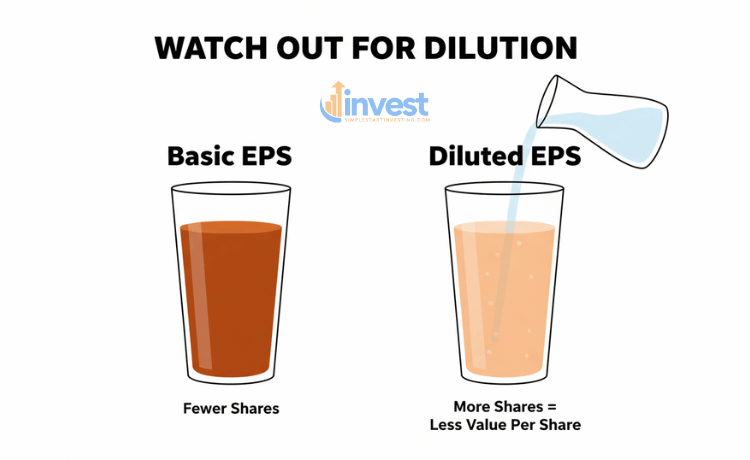
Diluted EPS, however, is the “worst-case scenario” or “reality check” number. Companies often give their employees “stock options” or “convertible bonds” as part of their pay. These are not shares yet, but they could become shares in the future. Diluted EPS assumes that all of those “extra” potential shares have already been created. Going back to our Amazon example, if there are 100 shares now but another 20 shares waiting in the wings for employees, the Diluted EPS would divide the 100 dollars by 120 shares. This makes the EPS look smaller (about 83 cents instead of 1 dollar).
New investors often make the mistake of only looking at the higher Basic EPS number. This can lead to a “nasty surprise” later on. If a company issues a lot of new shares to its executives, your “slice of the pie” gets smaller—a process called dilution. By focusing on Diluted EPS, you are seeing a more honest picture of what your share is actually worth if everyone “cashed in” their options.
Always remember: In the world of investing, more shares usually means your individual share owns less of the company. A company that keeps its share count stable while growing its profit is a “shareholder-friendly” business.
Can EPS Be Faked? Understanding “Financial Engineering”
While Earnings Per Share is a fantastic tool, it is not perfect. Because it is a result of a division problem (Profit divided by Shares), a company can make its EPS look better in two ways: by making more profit (the good way) or by reducing the number of shares (the “sneaky” way).
Let’s look at a massive company like Apple (AAPL). Apple is famous for something called “Stock Buybacks.” This is when the company uses its extra cash to buy its own stock back from the market and then “destroys” those shares. When the total number of shares goes down, the Earnings Per Share goes up automatically, even if the total profit didn’t grow at all.
Imagine a pizza cut into 8 slices. If you take 2 slices away and throw them in the trash, the remaining 6 slices are now bigger pieces of the total pizza. This is what a buyback does. While this isn’t “illegal” or “bad”—it actually helps shareholders—it can sometimes hide the fact that a company is struggling to grow its actual business. If a company’s total profit is flat for five years, but they keep buying back shares, their EPS will look like it’s growing, which might trick a beginner into thinking the company is expanding when it’s really just shrinking its share count.
A common mistake is assuming that a rising EPS always means the company is selling more products. Sometimes, it just means the company has a lot of cash to play “financial engineering” games. To be a smart investor, you should look at both the EPS growth and the total net income growth. If they are both going up together, you likely have a winner.
The mindset adjustment here is to be a “detective.” Don’t just accept the EPS number at face value. Ask yourself: “Is this company making more money because they are winning in the market, or are they just making the ‘slices’ bigger by having fewer of them?”
Comparing EPS Across Different Industries
One of the biggest traps for beginners is trying to compare the Earnings Per Share of two completely different companies. For instance, you might see that Costco (COST) has an EPS of 15 dollars, while Tesla (TSLA) has an EPS of 3 dollars. At first glance, you might think, “Wow, Costco is 5 times better than Tesla!”
This is a dangerous logic. Every industry has different “norms.” A retail giant like Costco has been around for decades and has a very stable, high-volume business. A high-growth tech or car company like Tesla might be reinvesting almost all of its money back into building new factories, which keeps its current EPS lower but aims for massive growth in the future.
Furthermore, the number of shares a company has is completely arbitrary. A company can choose to have 1 million shares or 1 billion shares. This choice drastically changes the EPS number but doesn’t change the actual value of the company. Comparing the EPS of Microsoft to the EPS of Ford is like comparing an apple to an orange; they are both fruits, but they grow in completely different ways.
Instead of comparing one company to another, use Earnings Per Share to compare a company to itself over time. Look at what Microsoft’s EPS was last year, the year before, and five years ago. Is it trending upward? That trend is much more important than the actual dollar amount. A company that consistently grows its EPS by 10% or 15% every year is often a much better investment than a company with a high EPS that is shrinking.
The key takeaway is to stay within the “neighborhood.” Compare retail companies to other retail companies, and tech companies to other tech companies. Most importantly, focus on the “growth story” of the specific company you are researching.
The Link Between EPS and the P/E Ratio
Once you understand Earnings Per Share, you have unlocked the key to understanding the most famous metric in all of investing: the P/E Ratio (Price-to-Earnings Ratio). You will see this ratio on every single stock chart. It is calculated by taking the current stock price and dividing it by the EPS.
Think of the P/E Ratio as the “price of admission.” If a stock costs 100 dollars and its EPS is 5 dollars, its P/E ratio is 20. This means you are paying 20 dollars for every 1 dollar of profit the company makes. It tells you how much the market is willing to pay for the company’s “earnings power.”
If a company has a very high Earnings Per Share growth, like Nvidia did during the AI boom, investors are often willing to pay a very high P/E ratio (maybe 50 or 100) because they expect those earnings to explode in the future. However, for a slow-moving utility company, investors might only be willing to pay a P/E of 10 or 15.
Beginners often make the mistake of buying a stock just because the EPS is high, without looking at the price. If you pay 1,000 dollars for a stock that only earns 1 dollar per share, you are paying a P/E of 1,000. That is incredibly expensive! You might have to wait decades for the company’s profit to catch up to the price you paid.
By mastering EPS, you can finally judge if a stock is “expensive” or “cheap.” A stock isn’t “cheap” just because it costs 5 dollars. It is only cheap if its Earnings Per Share is high compared to that 5-dollar price. This is how you find real deals in the stock market.
Summary: Your Checklist for Using EPS
As a new investor, Earnings Per Share should be one of the first things you check before putting your hard-earned money into a stock. It is the most direct link between a company’s business success and your bank account. Here is a quick checklist to keep in mind:
- Check the Trend: Is the EPS growing year over year? Consistent growth is a sign of a healthy, competitive business.
- Look at Diluted EPS: Don’t get fooled by the “Basic” number. Look at the “Diluted” version to see the impact of potential new shares.
- Compare to Expectations: During earnings season, see if the company “beat” the analysts’ estimates. This tells you if the company is performing better than the professionals expected.
- Watch for Buybacks: If EPS is going up but total profit is flat, the company might be using buybacks to manufacture growth.
- Use it for Valuation: Use the EPS to calculate the P/E ratio so you know if you are overpaying for the stock.
Investing can feel like a maze of confusing numbers and charts. But if you focus on the core reality—that a stock is a piece of a business and that business exists to make a profit—then Earnings Per Share becomes your North Star. It cuts through the noise and shows you exactly what your “slice” of the corporate pie is worth.
Regulations and accounting rules regarding how earnings are reported can change; please check current guidelines from the SEC or consult with a financial professional.
Disclaimer: This content is for educational purposes only and does not constitute financial advice. Investing involves risk, including the potential loss of principal.