For decades, we have been told that buying a home is the ultimate sign of “making it” in America. You might have heard your parents or friends say that renting is just “throwing money away” or that a mortgage is the best way to build wealth. But as the world changes, so does the math behind where you live.
Deciding whether to rent or buy a home is one of the biggest financial choices you will ever make. It is not just about having a place to sleep; it is a major investment of your time, your cash, and your future flexibility. This year, with shifting interest rates and new tax rules, the answer is not as simple as it used to be.
In this guide, we are going to peel back the layers of homeownership and renting. We will look at the hidden costs that most people ignore and help you figure out which path actually moves you closer to your financial goals. Whether you are eyeing a suburban house or a city apartment, let’s find out what makes sense for your wallet.
What Does “Renting vs. Buying” Actually Mean?
At its simplest level, renting means you are paying for “shelter as a service.” You pay a monthly fee to a landlord, and in exchange, you get a place to live without the responsibility of fixing a leaky roof or paying for property taxes. When the lease is up, you can walk away with nothing but your suitcase.
Buying a home, on the other hand, means you are purchasing an asset. Most people do this by taking out a mortgage loan from a bank. You pay a down payment upfront and then make monthly payments for 15 or 30 years. Over time, as you pay down the loan and the home value hopefully goes up, you build “equity,” which is the portion of the home you truly own.
The Real Cost of Renting
When you rent, your monthly payment is the maximum you will pay for housing that month. If the water heater explodes at 2:00 AM, you call the landlord. They pay for the repair, not you. Your financial risk is limited to your monthly rent and your security deposit.
The Real Cost of Buying
When you buy, your mortgage payment is the minimum you will pay for housing that month. On top of that check you send to the bank, you are responsible for everything else. This includes property taxes, homeowners insurance, and the “surprise” costs of maintenance. If that same water heater explodes, the bill is entirely yours.
Is Renting Really “Throwing Money Away”?
This is the most common phrase used to pressure people into buying. The idea is that rent money disappears forever, while mortgage money goes into your “house piggy bank.” But this is a massive oversimplification that leads many beginners into bad deals.
Deep Dive: The Unrecoverable Costs of Both
To understand the truth, we have to look at “unrecoverable costs.” These are dollars you spend that you never get back, no matter what.
Step 1: Plain English Explanation In both renting and buying, there are costs that provide zero return on investment. In renting, that cost is the rent itself. In buying, unrecoverable costs include mortgage interest, property taxes, homeowners insurance, and maintenance. You don’t get that money back when you sell the house; it’s gone.
Step 2: Real-World Example Imagine you rent an apartment for 2,000 dollars a month. At the end of the year, you have spent 24,000 dollars. That money is gone. Now, imagine you buy a house with a mortgage. Your payment is also 2,000 dollars. However, 1,400 dollars of that might go toward interest to the bank, 300 dollars toward property taxes, and 100 dollars toward insurance. Only 200 dollars actually goes toward paying off the house (building equity). In this case, you “threw away” 1,800 dollars that month to the bank and the government.
Step 3: Common Beginner Misconception New investors often think, “If my rent is 2,000 dollars and a mortgage is 2,000 dollars, I should buy so I can stop wasting money.” They forget that the bank takes a huge cut of that mortgage payment in interest, especially in the early years of the loan.
Step 4: The Correct Financial Logic You should compare the total “wasted” money of renting (the rent) against the total “wasted” money of buying (interest, taxes, maintenance). If the rent is lower than the sum of those homeownership costs, renting might actually be the faster way to build wealth if you invest the difference in the stock market.
The “Phantom Costs” of Owning a Home
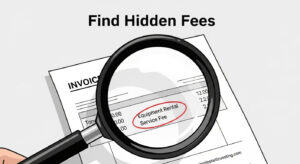
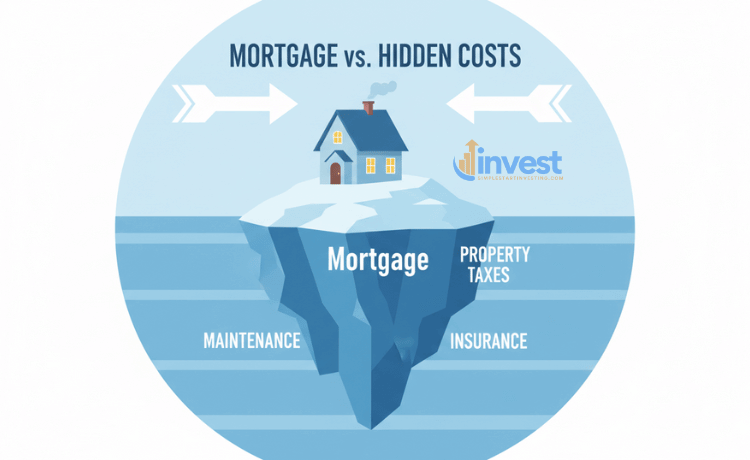
When you look at a listing on a site like Zillow, you see the price of the house. But the price of the house is not the cost of owning the house. Homeowners face what we call “phantom costs”—expenses that stay hidden until they hit your bank account.
Property Taxes and Insurance
Every year, you must pay the government a percentage of your home’s value. In some states, this can be 1% or even 2% of the home’s value every single year. If your home is worth 400,000 dollars, you might owe 4,000 to 8,000 dollars a year just in taxes. On top of that, insurance is required to protect your asset from fire or storms.
The 1% Maintenance Rule
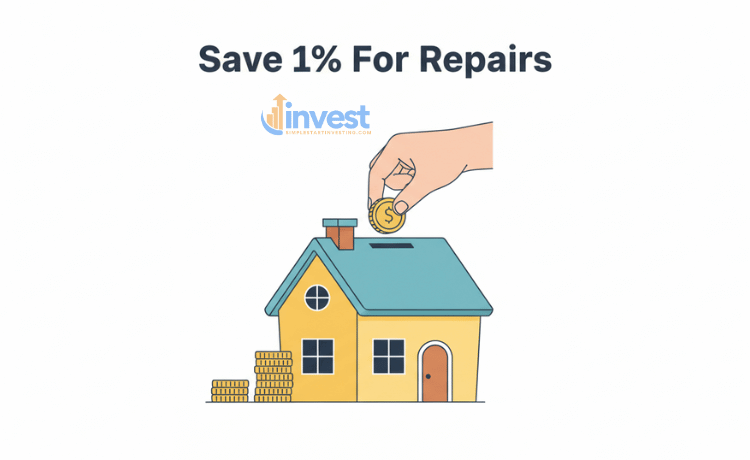
A good rule of thumb for beginners is the “1% Rule.” This suggests you should set aside 1% of your home’s total value every year for repairs.
Step 1: Plain English Explanation Houses are constantly breaking down. Roofs leak, pipes burst, and air conditioners stop working. These aren’t “if” questions; they are “when” questions. You need to budget for these before they happen so you aren’t forced to use high-interest credit cards.
Step 2: Real-World Example If you buy a beautiful home for 500,000 dollars, you should expect to spend about 5,000 dollars a year on maintenance. Some years you might only spend 500 dollars on a new faucet, but five years later, you might need a 20,000 dollar roof. The 5,000 dollar average helps you stay prepared.
Step 3: Common Beginner Misconception Many first-time buyers think, “The house is in great shape, so I won’t have any repair costs for a long time.” They spend all their savings on the down payment and have zero “emergency fund” left.
Step 4: The Correct Financial Logic A home is a physical object exposed to the elements. It is guaranteed to degrade over time. Treating maintenance as a mandatory “subscription fee” for your house—not a surprise—is the only way to own a home without going into debt.
Opportunity Cost: The Money Your Money Could Have Made
One of the biggest “invisible” costs of buying a home is what happens to your down payment. To buy a house, you usually need to put down a large chunk of cash—often 3% to 20% of the purchase price.
What Else Could That Money Do?
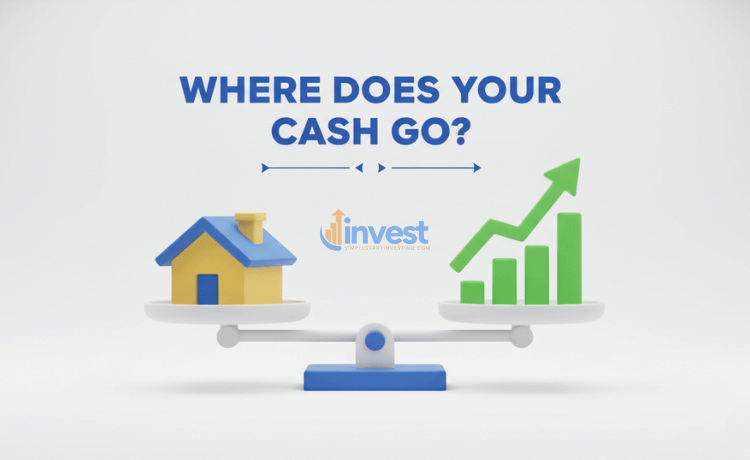
If you put 100,000 dollars down on a house, that money is now “locked” in the walls. It isn’t earning interest in a bank, and it isn’t growing in the stock market.
Step 1: Plain English Explanation Opportunity cost is the profit you give up by choosing one path over another. If you use your savings for a house, you are choosing NOT to use those savings for other investments like stocks or bonds.
Step 2: Real-World Example Let’s say you have 50,000 dollars. You can use it as a down payment for a home, or you can invest it in a broad market fund that tracks the S&P 500 (like a collection of companies like Apple, Amazon, and Walmart). Historically, the stock market has often grown faster than home prices. If the stock market returns 10% in a year, your 50,000 dollars would have earned 5,000 dollars. By putting it in the house, you “lost” the chance to earn that 5,000 dollars.
Step 3: Common Beginner Misconception Beginners often focus only on how much the house price goes up. They say, “My house went up 20,000 dollars this year!” but they ignore that the same money in the stock market might have gone up 30,000 dollars with zero maintenance work required.
Step 4: The Correct Financial Logic Buying a home is often more about “forced savings” than “maximum growth.” It forces you to build wealth every month. However, if you are disciplined enough to invest in the stock market, renting and investing the difference can sometimes lead to a much larger fortune over 30 years.
The 2026 Tax Landscape: What You Need to Know
Tax laws in the United States changed significantly recently, and it affects the “Rent vs. Buy” math. For a long time, the “Mortgage Interest Deduction” was the main reason people bought homes. But things look different now.
The Standard Deduction Challenge
Most Americans now take the “Standard Deduction” when they file their taxes. For a single person this year, that deduction is 16,100 dollars. For a married couple, it is 32,200 dollars.
What this means: You only get a tax break for owning a home if your total deductible expenses (like mortgage interest and property taxes) are higher than those standard amounts. For many people buying a moderately priced home, they won’t reach that level. This means the “tax benefits” of owning a home might be exactly zero for the average person.
The New SALT Cap
There is a bit of good news for homeowners in high-tax states. The “SALT” (State and Local Tax) deduction cap, which used to be limited to 10,000 dollars, has been raised to 40,000 dollars for most people. This means if you live in a place with high property taxes, you might finally be able to deduct more of those costs from your federal taxes.
Note: Tax regulations can change; please check current IRS guidance or consult a professional.
Lifestyle: The Non-Financial Side of the Choice
Money isn’t everything. Sometimes the best financial choice is the one that fits your life goals.
Flexibility vs. Stability
Renting gives you the power of mobility. If you get a better job offer across the country, you can move when your lease ends. In the modern economy, the ability to move for a 20% pay increase is often worth more than the equity you would build in a house.
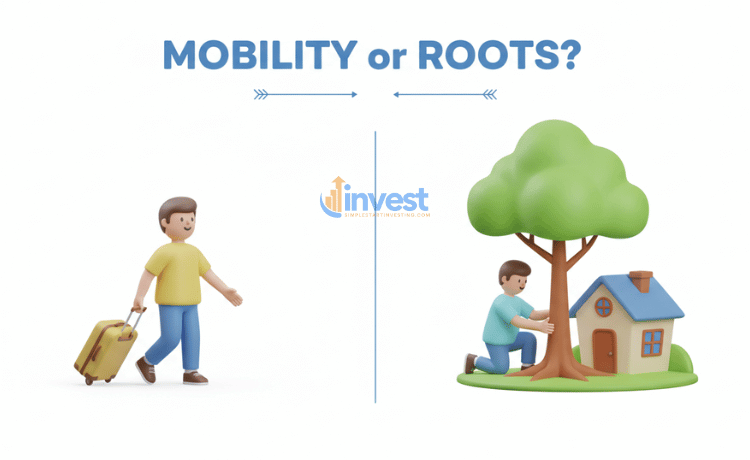
Buying gives you stability and control. You can paint the walls purple, knock down a wall to make a bigger kitchen, and never worry about a landlord telling you to leave. If you plan to stay in one city for more than 7 to 10 years, buying usually becomes the better financial move because you have enough time to recover the high costs of buying and selling (like agent fees and closing costs).
The “Buy and Hold” Rule
If you don’t think you can stay in a house for at least five years, renting is almost always the better choice. Between the 3% you pay to buy and the 6% you often pay to sell, you need the house to grow significantly in value just to break even.
How to Decide: A Step-by-Step Logic
Since we aren’t using complex math or tables, let’s use a logical checklist to see where you stand.
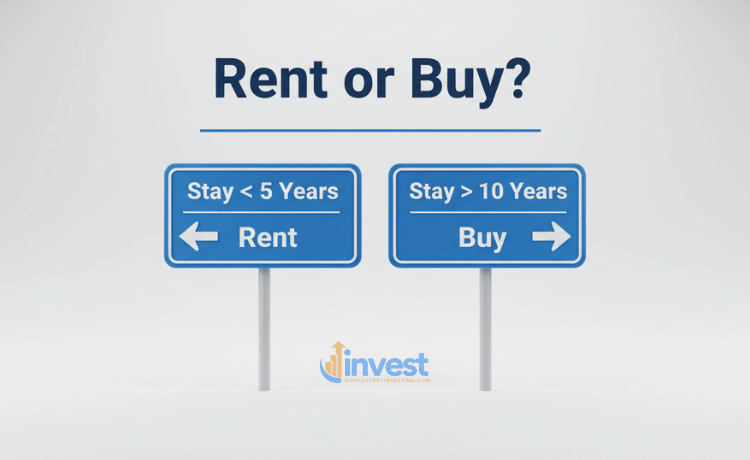
1. How long will you stay?
- Less than 5 years: Renting is likely better.
- 5 to 10 years: It’s a toss-up; look at the local market.
- 10+ years: Buying usually wins.
2. Is the “Rent Ratio” in your city high or low? In some cities, like San Francisco or New York, it is much cheaper to rent a million-dollar apartment than it is to pay the mortgage and taxes on it. In smaller towns, the mortgage might be cheaper than rent. Compare the monthly rent for a house to the total monthly cost (interest, tax, insurance, maintenance) of buying that same house.
3. Do you have an emergency fund? If buying a home leaves you with 0 dollars in the bank, you are one broken pipe away from a financial disaster. Renting is safer until you have both a down payment and a separate “life happens” fund.
Summary: Your Path Forward
There is no “wrong” choice, only the choice that is wrong for your current situation. Renting is not a failure; it is a strategic choice that buys you time and flexibility. Buying is not a guaranteed “gold mine”; it is a long-term commitment to a physical asset that requires constant care.
If you are a beginner, don’t let social pressure or old clichés drive your decision. Look at the unrecoverable costs, consider what your down payment could earn if invested in companies like Costco or Tesla instead, and be honest about how long you want to live in one spot.
Financial freedom isn’t about owning a deed to a house—it’s about having more assets than liabilities. Whether those assets are in a backyard or a brokerage account is up to you.
Disclaimer: This content is for educational purposes only and does not constitute financial advice. All investments, including real estate, carry risk. Please consult with a qualified financial or tax professional before making major financial decisions.