Congratulations! You have navigated the choppy waters of house hunting, mortgage applications, and inspections. Now, you have reached the final destination: Closing Day. This is the day when the property officially changes hands, you sign a mountain of paperwork, and you finally get the keys to your new home. For many beginners, Closing Day feels like a mysterious and slightly intimidating ritual, but it is actually a structured legal process designed to protect everyone involved.
In simple terms, Closing Day is the official transfer of ownership from the seller to the buyer. Think of it as the “finish line” of a marathon. During this meeting, you will finalize your mortgage loan, pay your remaining costs, and legal documents will be recorded with the local government. While it might take a few hours of sitting in an office or a conference room, being prepared ensures that no last-minute hiccups prevent you from moving in.

What Exactly Is Closing Day?
To understand Closing Day, imagine you are buying a very expensive piece of equipment from a friend, but you are using a loan from a bank to pay for it. Because the bank is involved and the government needs to know who owns the land, you cannot just hand over cash and take the keys. You need a formal meeting to make sure the title is “clear” (meaning no one else claims to own the house), the money is sent to the right people, and the deed is signed over to you.
How It Works in Simple Terms
The Closing Day process involves three main moving parts. First, you fulfill the legal requirements of your loan by signing the “Promissory Note,” which is your promise to pay the bank back. Second, you pay your “Closing Costs” and the remainder of your down payment. Third, the seller signs the deed, which is the document that proves you now own the property. Once the local county office records this deed, the transition is legally complete.
A Real-World Example
Let’s say you are buying a home from a seller who uses a large national moving company. You have been working with a lender like Chase or Wells Fargo. On Closing Day, you meet at a Title Company office. You bring a certified check or have already wired your funds. You spend about an hour signing your name dozens of times. Once the Title Agent confirms the funds have arrived in the seller’s account and the documents are notarized, they hand you a heavy set of keys. You are now a homeowner.
Common Beginner Misconception
Many first-time buyers believe that Closing Day is just a “meet and greet” where you shake hands and get keys. They think the “hard work” ended when the offer was accepted.
The Financial Logic Shift
In reality, Closing Day is a high-stakes legal event. If you forget a specific form of ID or if your bank transfer is delayed by ten minutes past a certain “cutoff” time, the entire move could be delayed by days. You must treat this day with the same level of detail as a court hearing or a major business merger. It is the final “audit” of your entire home-buying journey.
Who Will Be at the Closing Table?
Depending on which state you live in, the people present during Closing Day can vary. However, there is usually a standard group of professionals who ensure the process goes smoothly.

- The Closing Agent: This person is often from a Title Company or might be an attorney. They are neutral third parties who coordinate the paperwork and make sure the money goes where it is supposed to go.
- The Buyer (You): You are the most important person there! You will be doing most of the signing.
- The Seller: Sometimes the seller signs their papers earlier in the day or even the day before, so you might not actually see them.
- Real Estate Agents: Both your agent and the seller’s agent often attend to celebrate and ensure any final disputes are settled.
- The Lender: It is rare for a bank representative to be there in person, but they are “virtually” present because the Closing Agent is constantly communicating with them to get the final “clear to close.”
A Real-World Example
If you are buying a condo in a city like Seattle, your agent from a firm like RE/MAX might sit next to you to explain things in plain English while the Closing Agent from a company like First American Title walks you through the legal jargon.
Common Beginner Misconception
New buyers often think they need to bring their own lawyer to the table to “fight” for them.
The Financial Logic Shift
While some states (like New York or Georgia) require an attorney to be present, in many other states, the Title Company acts as the neutral administrator. You do not need to be “combative” at closing. The “negotiating” phase ended weeks ago. This meeting is simply about executing the contracts you already agreed upon.
What Documents Will You Be Signing?
Prepare your hand for a workout! You will sign a stack of papers on Closing Day, but three of them are the “heavy hitters” you should pay the most attention to.
1. The Closing Disclosure (CD)
This is a five-page document that outlines the final details of your loan. It includes your interest rate, monthly payment, and exactly how much you are paying in fees. You should have received a “preliminary” version of this three days before closing.
2. The Promissory Note
This is perhaps the most important document for your finances. It is the legal “I.O.U.” to the bank. It states exactly how much you are borrowing, the interest rate, and the penalties if you fail to pay.
3. The Deed of Trust (or Mortgage)
This document gives the lender a “lien” on your property. In simple terms, it says that if you don’t pay back the loan as promised in the Promissory Note, the bank has the legal right to take the house back (foreclosure).
A Real-World Example
Imagine you see a charge on your Closing Disclosure for 500 dollars that you don’t recognize. Instead of panicking, you ask the Closing Agent. They explain it is a “Title Insurance” fee that protects you if someone later claims they actually own your land. Because you checked the document carefully, you now understand exactly what you are paying for.
Common Beginner Misconception
Many people feel pressured to sign everything as fast as possible because they don’t want to “waste time” or look “slow.”
The Financial Logic Shift
This is likely the largest financial commitment of your life. It is your right—and your responsibility—to read every page. If a number looks different than what you were quoted two weeks ago, stop and ask. The “Logic of the Signature” is that once you sign, you are legally bound to those terms, regardless of whether you read them or not.
The “Checklist”: What You Must Bring
Walking into Closing Day empty-handed is a recipe for disaster. You need a few specific items to ensure the keys end up in your pocket by the end of the hour.
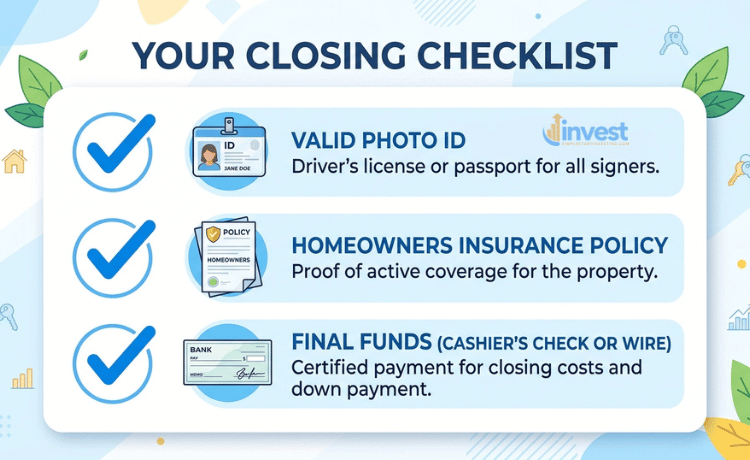
1. A Valid Photo ID
This seems obvious, but it must be a government-issued ID that is not expired. A driver’s license or passport is best. If your license expired yesterday, the notary cannot legally witness your signature, and the closing will stop immediately.
2. Proof of Homeowners Insurance
The bank will not give you hundreds of thousands of dollars to buy a house if that house isn’t insured against fire or storms. You usually need to bring a “binder” or a receipt showing you have paid for the first year of insurance.
3. The Funds (Cashier’s Check or Wire Confirmation)
You cannot use a personal check or a credit card for your down payment and closing costs. You must either have a “Cashier’s Check” from your bank or have sent a “Wire Transfer” at least 24 hours in advance.
A Real-World Example
Suppose your total “Cash to Close” is 45,200 dollars. You go to your local Chase branch the day before and ask for a Cashier’s Check made out to the Title Company. You bring that physical check to the meeting. If you tried to write a personal check from your checkbook, the Title Company would refuse it because personal checks can “bounce,” and they need “guaranteed funds.”
Common Beginner Misconception
Many buyers think they can just “Zelle” or “Venmo” the money to the seller or the agent.
The Financial Logic Shift
Real estate involves massive sums of money, making it a prime target for “Wire Fraud.” Title companies use extremely secure, specific methods for transferring money. Always call your Title Company using a verified phone number from their official website to confirm wire instructions. Never trust an email that says “The wire instructions have changed, send money here instead.” That is almost always a scam.
Understanding Closing Costs (Without the Math)
You have probably heard that you need to pay “Closing Costs” on top of your down payment. These are the fees for the professionals who helped you buy the house. Generally, these costs range from 2 percent to 5 percent of the home’s purchase price.
Where Does the Money Go?
Instead of using a complex formula, think of it like this:
- A portion goes to the government to record the new deed.
- A portion goes to the bank to process your loan (origination fees).
- A portion goes to the Title Company to research the history of the house.
- A portion goes into an “Escrow Account” to pay for your future property taxes and insurance.
A Simple Arithmetic Example
If you are buying a home for 300,000 dollars and your closing costs are 3 percent, you will need to pay 9,000 dollars in fees. If your down payment is 10 percent (30,000 dollars), your total “Cash to Close” would be 39,000 dollars. You should always have a little extra “cushion” in your bank account just in case these fees shift slightly at the last minute.
Common Beginner Misconception
Buyers often think the seller pays all the fees, or that the fees are “included” in the loan amount automatically.
The Financial Logic Shift
While you can sometimes negotiate for the seller to pay some of your costs (called “Seller Concessions”), you should always plan to pay them yourself. If you don’t have the cash for closing costs, you can’t buy the house, even if the bank approved your mortgage. This is why “saving for a house” means saving for the down payment plus the closing costs.
The Final Walkthrough: The Last Step Before the Table
Usually, 24 hours before Closing Day, you will do a “Final Walkthrough” of the property. This is NOT an inspection. This is a quick visit to ensure the house is in the same condition it was when you signed the contract.

What to Look For
- Did the seller move out all their trash?
- Are the appliances that were supposed to stay (like the fridge or stove) still there?
- Did a pipe burst or a window break since you last saw it?
- Did the seller complete the repairs they promised after the inspection?
A Real-World Example
Imagine you walk into the kitchen during your walkthrough and notice the seller took the expensive Samsung refrigerator that was explicitly listed as “included” in the contract. You tell your agent immediately. Your agent then calls the seller’s agent. They might agree to give you a 1,500 dollar credit at the closing table to buy a new one, or they might force the seller to bring it back before you sign the final papers.
Common Beginner Misconception
New buyers often skip the walkthrough because they are busy packing or they “trust” the seller.
The Financial Logic Shift
Once you sign the papers at the closing table, the house is yours—along with all its problems. If you find out the basement flooded after you sign, you are responsible for the bill. The walkthrough is your last piece of “leverage.” Once the money is transferred, that leverage disappears.
The Logic of the “Clear to Close”
A few days before your scheduled date, your loan officer will tell you that you are “Clear to Close.” This is the best phrase in real estate! It means the bank’s “underwriter” has done a final check of your finances and is ready to send the money.

The Final Credit Check
Be warned: the bank will often check your credit one last time right before Closing Day. This is the most dangerous time for your loan.
A Real-World Example
Suppose you are excited about your new home, so you go to a furniture store like IKEA or West Elm and buy 5,000 dollars worth of furniture on a new credit card. On the morning of your closing, the bank sees this new debt. Suddenly, your “Debt-to-Income” ratio is too high, and the bank cancels your loan at the very last second. You lose the house and your deposit.
Common Beginner Misconception
“I’m already approved, so I can start spending money on my new life now.”
The Financial Logic Shift
The bank’s approval is “conditional” until the very moment the deed is recorded. Until you have the keys in your hand, do not change anything about your financial life. Do not quit your job, do not buy a car, and do not move large amounts of money between bank accounts unless your lender tells you to. Keep your finances “frozen” in time.
What Happens After You Sign?
Once the last document is signed and the Title Agent confirms the funds, you might think it’s time to pop the champagne. It is! But there are a few “boring” things that happen behind the scenes.
- Funding: The lender sends the actual money to the Title Company.
- Disbursement: The Title Company pays off the seller’s old mortgage, pays the real estate agents their commission, and pays the government fees.
- Recording: A clerk at the county office records the deed. This makes it “public record” that you are the owner.
- The Keys: You finally receive the keys, garage door openers, and any alarm codes.

Important Note on Regulations
Real estate laws and tax rules (regulated by the IRS and local authorities) can change. For example, some states are moving toward fully digital “e-closings,” while others still require a physical notary. Always check with your local professional for the most current rules in your specific area.
Summary Checklist for a Successful Closing Day
- Confirm the Time and Place: Ensure you know if you are meeting at an attorney’s office or the Title Company.
- Bring Your ID: Double-check that it is not expired.
- Bring the Money: Ensure your Cashier’s Check or Wire is ready.
- The Final Walkthrough: Do not skip this! Check the appliances and the condition of the home.
- Read Before You Sign: Don’t be afraid to ask, “What does this paragraph mean?”
- Stay Financially Boring: No new credit cards or big purchases until after the keys are yours.
Closing Day is the start of a new chapter. By understanding the documents, the people involved, and the financial logic behind the process, you can walk into that room with confidence. You aren’t just signing papers; you are securing your future.
Disclaimer: This content is for educational purposes only and does not constitute financial, legal, or tax advice. Regulations regarding real estate transactions vary by state and are subject to change; please consult with a qualified professional or check current IRS and local guidelines before making any financial decisions.