Finding your dream home in the United States is an emotional journey, but the moment you decide to move forward, it becomes a business transaction. To get the keys, you must submit a real estate offer that appeals to the seller without draining your bank account more than necessary.
A real estate offer is a formal, written proposal to purchase a property. It is much more than just a price tag; it is a legally binding contract that outlines the terms, conditions, and timeline of the sale. For a beginner, this document can feel overwhelming, but understanding its components is the secret to winning in a competitive market like Florida, Texas, or California.
In this guide, we will break down how to balance your bid, protect your interests, and navigate the nuances of the American housing market so you can stop searching and start packing.
What Exactly Is a Real Estate Offer?
At its simplest level, a real estate offer is your “opening move” in the game of home buying. It tells the seller that you are serious about their property and details exactly what you are willing to give in exchange for the deed.
Most beginners think the offer is just about the “purchase price.” While the price is a huge factor, the seller also cares about how quickly you can close, how much cash you have ready right now, and what “strings” are attached to the deal.
In the U.S., these offers are usually prepared by your buyer’s agent using standardized state forms. Once the seller signs your offer without making any changes, you are officially “under contract.” This is why getting the details right the first time is so important.
The “Net Proceeds” Logic
Beginners often make the mistake of thinking the highest number on the page always wins. However, sellers focus on “Net Proceeds,” which is the amount of money they actually walk away with after all costs are paid.

Imagine two people bidding on a house in Atlanta listed for 400,000 dollars. Buyer A offers 410,000 dollars but asks the seller to pay 10,000 dollars toward their closing costs. Buyer B offers 405,000 dollars but asks for nothing. Even though Buyer A’s offer looks “higher,” the seller actually gets the same amount from both. The seller might choose Buyer B because the deal is simpler.
The Three Pillars of a Strong Offer
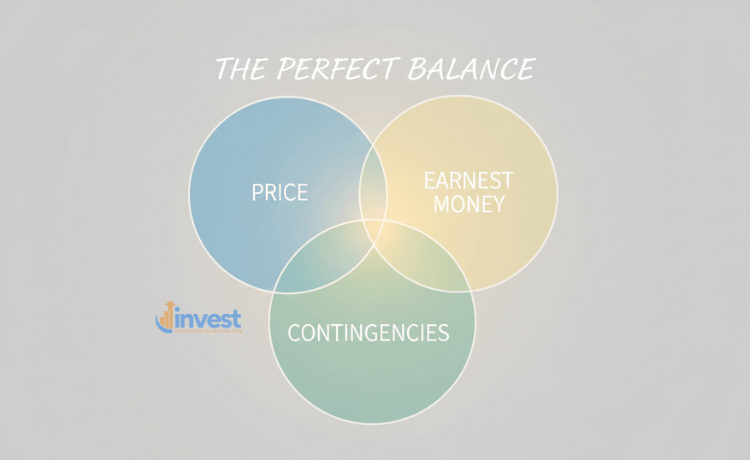
To create a winning real estate offer, you need to balance three main components: the price, the earnest money, and the contingencies. Think of these as three dials you can turn to make your proposal more or less attractive.
1. The Purchase Price: Finding the “Sweet Spot”
The price is the most visible part of your real estate offer. To avoid overpaying, you must look at “Comps” (comparable sales). These are similar homes in the same neighborhood that sold within the last three to six months.
If a house is listed at 500,000 dollars, but all the Comps in the neighborhood sold for 480,000 dollars, offering the full list price might mean you are overpaying. Conversely, in a “hot” market like Phoenix, you might need to offer slightly above the list price to even be considered.
Common Beginner Mistake: Offering a round number just because it feels right. The Better Way: Use a specific number based on data. If you offer 482,500 dollars instead of 480,000 dollars, it shows the seller you have done precise math and are serious about the value, rather than just guessing.
2. Earnest Money: Showing “Good Faith”
Earnest money is a deposit you make to show the seller you are committed. It is like a “down payment on your down payment.” This money is held in a special “escrow” account by a neutral third party, not the seller directly.
In a typical U.S. transaction, earnest money is usually between 1 percent and 3 percent of the purchase price. For a 300,000 dollar home, this would be between 3,000 dollars and 9,000 dollars.
Common Beginner Mistake: Offering too little earnest money because they want to “keep their cash safe.” The Better Way: A larger earnest money deposit makes your real estate offer look much stronger without actually increasing the total cost of the home. It tells the seller, “I am so confident I will buy this house that I am willing to put this money at risk.” If the deal goes through, that money goes toward your down payment anyway.
3. Contingencies: Your Safety Exit
Contingencies are “what-if” clauses that allow you to cancel the contract and get your earnest money back if something goes wrong. The most common ones are inspection, appraisal, and financing.
While these protect you, they are “risks” for the seller. A seller hates contingencies because they mean the deal could fall apart at any moment.
Navigating the Inspection Contingency
The inspection contingency is perhaps the most important protection for a new buyer. It gives you a set number of days (usually 7 to 10) to hire a professional to check the home’s roof, foundation, plumbing, and electrical systems.
If the inspector finds a major problem, like a cracked foundation or a roof that needs to be replaced, you can ask the seller to fix it, lower the price, or you can walk away with your earnest money.
The “Informational” Strategy
In very competitive markets, some buyers “waive” the inspection to win. This is extremely risky for a beginner. Instead of waiving it, you can offer an “inspection for informational purposes only.”
This means you will still do the inspection, and if you find a “deal-breaker” issue, you can still cancel the contract. However, you promise the seller you won’t ask for small repairs like a leaky faucet or a squeaky door. This gives the seller peace of mind that you won’t “nickel and dime” them.
The Appraisal Gap: A New Reality
When you take out a mortgage, the bank will hire an appraiser to make sure the house is actually worth what you are paying. If you offer 450,000 dollars for a house, but the appraiser says it is only worth 430,000 dollars, you have a “20,000 dollar appraisal gap.”

The bank will only lend you money based on the 430,000 dollar value. As the buyer, you must either find the extra 20,000 dollars in cash, or the seller must lower their price.
Common Beginner Mistake: Assuming the seller will automatically lower the price if the appraisal comes in low. The Better Way: If you know the market is competitive, you can include an “appraisal gap guarantee” in your real estate offer. This says, “I will pay up to 5,000 dollars in cash if the house appraises for less than my offer.” This makes your offer much more attractive to a seller who is worried about a low appraisal.
The Role of the Pre-Approval Letter
In the modern American market, you cannot even submit a real estate offer without a pre-approval letter from a lender. This letter is a document from a bank stating that they have checked your income, credit, and taxes, and they are willing to lend you a specific amount of money.
To a seller, an offer without a pre-approval letter is just a piece of paper. They have no proof that you can actually afford the house.

Example of Power: Imagine a seller receives two offers. One is for 505,000 dollars but has no letter. The other is for 500,000 dollars and includes a “fully underwritten” pre-approval letter from a reputable bank like Chase or a local credit union. The seller will almost always take the 500,000 dollar offer because it is a “sure thing.”
New Rules for 2026: Agent Commissions
It is important to note that the way real estate agents are paid changed recently due to new industry regulations. In the past, the seller almost always paid the commission for both their agent and your agent.
Now, your real estate offer might need to specify how your agent is being paid. You may ask the seller to cover your agent’s fee as a “seller concession,” or you might agree to pay it yourself. This is a new layer of negotiation that beginners must discuss with their agents before writing the offer.
Common Mistakes That Lead to Overpaying
Overpaying doesn’t just mean a high purchase price. It means losing money through bad terms or hidden costs.

Falling in Love with “The One”
When you are emotionally attached to a house, you are likely to ignore red flags or bid way beyond the home’s actual value. Beginners often get caught in “bidding wars” where they keep increasing their price by 5,000 dollars just to “beat” the other person.
The Fix: Set a “Walk-Away Price” before you even write the offer. If the price goes one dollar over that limit, you stop. There will always be another house.
Ignoring Closing Costs
Many beginners forget that they need cash for more than just the down payment. Closing costs—which include taxes, title insurance, and loan fees—usually cost between 2 percent and 5 percent of the home’s price.
If you buy a 400,000 dollar home, your closing costs could be as high as 20,000 dollars. If you spend every penny of your savings on the “offer price” to win the house, you won’t have enough money to actually close the deal.
Step-by-Step Logic for Your First Bid
When you are ready to write your real estate offer, follow this logical sequence to ensure it is fair and competitive:
- Analyze the Comps: Look at three similar houses that sold nearby. If they sold for an average of 350,000 dollars, that is your baseline.
- Adjust for Condition: Does the house you want have a brand-new roof? Add a few thousand dollars to your baseline. Does it need new carpet? Subtract some.
- Check Market Days: If the house has been on the market for 60 days, the seller might be desperate. You can offer a bit less. If it just hit the market yesterday, you likely need to offer the full list price or more.
- Factor in Interest Rates: If interest rates are high, there are fewer buyers, which gives you more “leverage” to ask for repairs or a lower price.
- Write the Offer: Use a clean, professional format. Ensure all your documents (pre-approval, proof of funds for the down payment) are attached.
Why Timing Matters
In real estate, “time is of the essence.” This is a standard phrase in American contracts. A winning real estate offer often has a “short fuse.”
If you submit an offer on Friday morning, you might give the seller until Saturday evening to respond. This prevents the seller from waiting until their Sunday “Open House” to see if they can get a better offer from someone else. By putting a deadline on your offer, you force the seller to make a decision while your offer is the best one on the table.
Summary of Mindset Shifts for Beginners
- Old Thinking: I should start with a “lowball” offer to see if they negotiate.
- New Thinking: In a competitive market, a “lowball” offer might get ignored completely. Start with a fair, data-backed offer to show you are a serious professional.
- Old Thinking: The seller only cares about the money.
- New Thinking: The seller cares about certainty. A fast closing date and fewer contingencies can be worth 5,000 dollars or 10,000 dollars to a seller who needs to move quickly.
- Old Thinking: I can figure out the repairs after I move in.
- New Thinking: Unforeseen repairs are the number one reason new homeowners go into debt. Always use your inspection window wisely.
Crafting a winning real estate offer is a balance of math and psychology. By staying grounded in the data, keeping your emotions in check, and understanding the protections available to you, you can secure a home that fits both your life and your budget.
Disclaimer: This content is for educational purposes only and does not constitute legal, financial, or real estate advice. Real estate laws and market conditions vary by state; please consult with a licensed professional in your area before making any financial decisions.