Have you ever wondered why some companies seem to dominate their industries for decades while others disappear after just a few years of success? If you are starting your journey into the world of stocks, you might have heard professional investors talk about a “moat.” This isn’t a term about medieval history or architecture. In the world of finance, moat investing is one of the most powerful strategies used by the world’s most successful investors, including Warren Buffett.
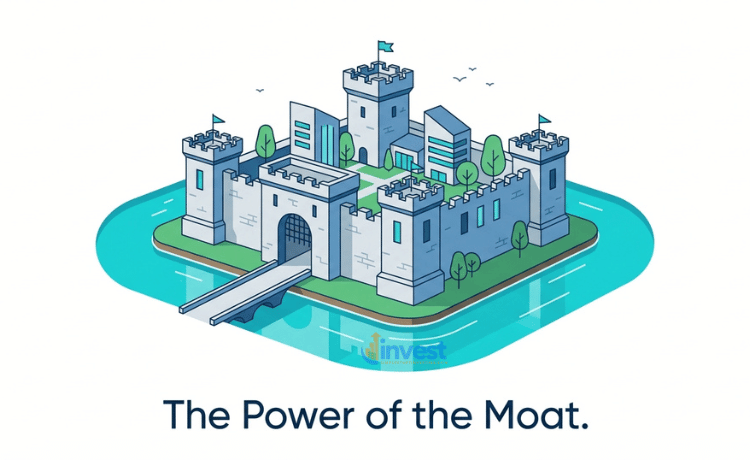
The idea is simple: just like a castle needs a wide, deep moat filled with water to protect it from invaders, a great company needs a “moat” to protect its profits from competitors. If a business makes a lot of money, other people will naturally want to start similar businesses to take those profits away. A moat is the special advantage that stops those competitors from succeeding.
In this guide, we are going to dive deep into the moat investing strategy. We will explain what it is, how to find it, and why it is the “secret sauce” for building long-term wealth in the US stock market. Whether you are looking at big names like Apple or local giants like Walmart, understanding the moat will change the way you look at every business.
What Exactly Is an Economic Moat?
Let’s break down this concept using our specialized four-step approach to ensure you truly grasp the logic behind it.
1. Plain English Explanation
An economic moat is a structural advantage that allows a company to keep competitors at bay and maintain high profits over a long period. It is something the company “owns” or “is” that cannot be easily copied by a rival. Without a moat, a company’s high profits act as a beacon, attracting competitors who will lower prices and eventually eat away at those profits until the original company is no longer special.
2. Real-World American Example
Think about Coca-Cola (KO). If you wanted to start a soda company today, you could easily make a drink that tastes similar to Coke. You could even use similar ingredients. However, you do not have the brand recognition that Coca-Cola has built over 100 years. People all over the world recognize the red label and the specific taste. Because of this “Brand Moat,” Coca-Cola can charge more for a bottle of sugar water than a generic store brand, and millions of people will still choose the Coke.
3. Common Beginner Misconception
Many new investors think that having a “great product” or “fast growth” is the same thing as having a moat. They see a company like a trendy clothing brand or a new tech gadget and assume it’s a safe bet because everyone is buying it right now. They mistake popularity for a sustainable advantage.
4. The Correct Financial Logic
Growth and popularity are temporary; a moat is permanent (or at least very long-lasting). A company can have a “cool” product today, but if another company can make the same thing cheaper or better next month, that original company has no moat. To be a successful long-term investor, you shouldn’t just look for who is winning today; you must look for who is protected from losing tomorrow.
The Four Main Types of Moats You Need to Know
Not all moats are built the same way. In the US market, most successful companies rely on one of these four types of “water” in their moat to keep the competition away.
1. The Brand and Intangible Assets Moat
This is the most famous type of moat. It includes things like brands, patents, and government licenses. If a brand is strong enough, customers will pay more for it simply because of the name.
- Example: Consider Apple (AAPL). While other phones might have similar cameras or screens, the Apple brand and the iOS software create a massive moat. People don’t just buy a phone; they buy an “iPhone.” This allows Apple to keep its prices high and its profit margins even higher.
- The Logic: If a company can raise prices and customers don’t leave, they have a brand moat.

2. The Switching Costs Moat
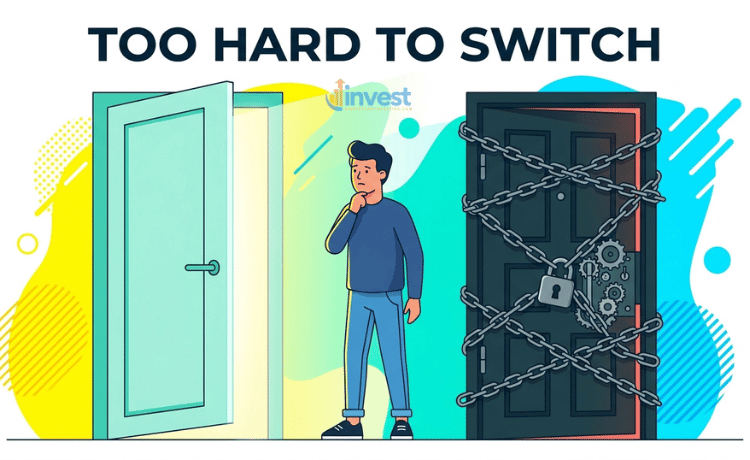
This moat exists when it is too difficult, expensive, or annoying for a customer to switch to a competitor. Even if a rival offers a slightly better price, the customer stays because the “cost” of moving is too high.
- Example: Think about Adobe (ADBE). Most professional designers and photographers use Photoshop. If they tried to switch to a different software, they would have to spend weeks learning new tools and moving all their files. It’s easier to just keep paying Adobe.
- The Logic: The “stickier” a product is, the deeper the moat.
3. The Network Effect Moat
This is one of the most powerful moats in the modern digital age. A network effect happens when a service becomes more valuable as more people use it.
- Example: Visa (V) and Mastercard (MA). Merchants accept Visa because almost every consumer has a Visa card. Consumers carry a Visa card because almost every merchant accepts it. It is almost impossible for a new company to start a new credit card network because they would need millions of users and millions of stores to join at the exact same time.
- The Logic: The value is in the connection of the users, not just the product itself.

4. The Cost Advantage Moat
Some companies are simply better at keeping costs low than anyone else. Because they can buy in massive quantities or have a more efficient way of doing things, they can sell products at a price that would bankrupt their competitors.
- Example: Costco (COST) or Walmart (WMT). Because these companies buy billions of dollars worth of goods, they get the lowest possible prices from suppliers. A small local grocery store cannot compete with Walmart’s prices because it costs the small store more just to buy the product than what Walmart sells it for.
- The Logic: Being the “low-cost leader” is a massive shield against competition.
Why New Investors Often Fail to See the “Trap”
One of the biggest dangers for a beginner is investing in a company that looks like it has a moat but actually doesn’t. This is often called a “Value Trap.”
1. Plain English Explanation
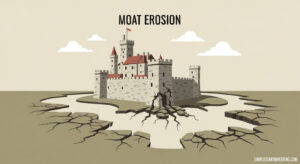
A value trap is a company that looks cheap or successful on the outside but is actually losing its competitive edge. The “moat” is drying up, and the castle is about to be invaded.
2. Real-World American Example
Think about Intel (INTC). For decades, Intel had a massive moat in computer chips. However, over the last few years, competitors like Nvidia (NVDA) and AMD started making better chips for specific uses like Artificial Intelligence and gaming. Intel’s moat wasn’t as deep as people thought, and the company has struggled as a result.
3. Common Beginner Misconception
Beginners often look at the past and assume the future will be the same. They think, “My parents used this brand, so it must be a good investment.” They ignore the fact that technology and consumer habits change.
4. The Correct Financial Logic
A moat is not a permanent guarantee. It requires constant maintenance. As an investor, you must ask: “Is this moat getting wider or narrower?” If a company is losing its technological lead or if customers are finding it easier to switch to a cheaper alternative, the moat is shrinking.
How to Calculate if a Moat is Working (The Simple Way)
You don’t need complex math or spreadsheets to see if a moat is real. You just need to look at how the company handles its money. We can use a simple logic of “Return on Capital.”
Imagine you open a lemonade stand. You spend 100 dollars on lemons, sugar, and a wooden stand. At the end of the summer, you have 120 dollars in total. This means you made 20 dollars of profit on your 100 dollar investment. That is a 20% return.
Now, imagine your neighbor sees you making money and opens their own stand. If you have no moat, they will lower their prices to attract your customers. To keep your customers, you have to lower your prices too. Next summer, you spend 100 dollars but only end up with 105 dollars. Your return has dropped to 5%.
The Moat Indicator: A company with a true moat will consistently earn a high return on the money it invests into its business, year after year, regardless of what the neighbors (competitors) do. If you see a company like Microsoft (MSFT) consistently making a high profit for every dollar they spend on their business, you are likely looking at a very wide moat.
The “Price” vs. “Value” Conflict
One of the hardest parts of moat investing is that everyone else knows these companies are good. Because companies like Amazon (AMZN) or Alphabet (GOOGL) have such obvious moats, their stock prices are often very high.
1. Plain English Explanation
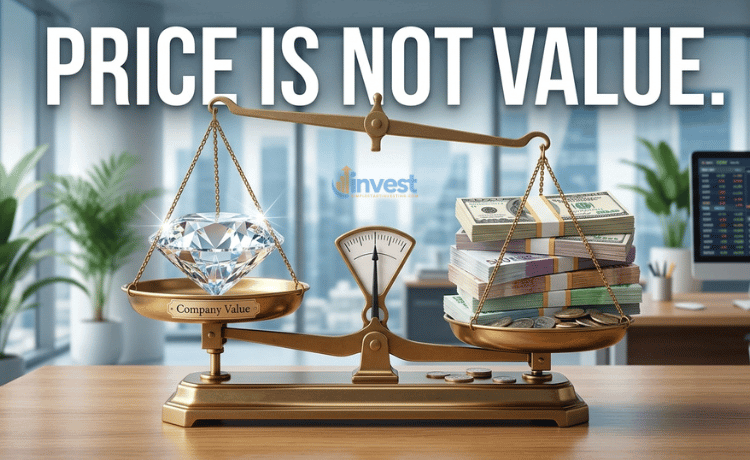
Just because a company has a great moat doesn’t mean you should buy it at any price. If you pay too much for a great company, your investment might still perform poorly.
2. Real-World American Example
Imagine a beautiful house in a perfect neighborhood with a literal moat around it. It’s the best house in town. However, if the house is worth 500,000 dollars and you pay 1,000,000 dollars for it, you have made a bad financial decision. Even though the house is great, you paid too much to ever make a profit when you sell it.
3. Common Beginner Misconception
“It’s a great company, so I’ll just buy it now and not worry about the price.” Beginners often ignore “valuation” (how much the stock is worth) because they are so excited about the “moat” (how good the company is).
4. The Correct Financial Logic
The goal of moat investing is to find a “Great Business at a Fair Price,” not a “Fair Business at a Great Price.” You want the castle, but you want to buy it when the market is a little bit scared and the price is reasonable.
Steps to Identify a Moat Before You Invest
If you are looking at a stock and want to know if it has a moat, ask yourself these three questions:
- If a competitor gave away 1 billion dollars to try and steal this company’s customers, would it work? For a company like Facebook (Meta), even 1 billion dollars might not work because people want to be where their friends are. That’s a network effect moat.
- Does the company have “Pricing Power”? If the company raised the price of its product by 10% tomorrow, would you still buy it? If the answer is yes (like with a Netflix subscription or a Starbucks coffee), they have a moat.
- Is it a “Mission Critical” product? If a business stopped using Microsoft Excel, their entire company would probably stop working. That is a switching cost moat.
Building Your Portfolio Around Moats
For a beginner, the moat investing strategy is about safety and longevity. Instead of chasing the “next big thing” that might disappear in two years, you are looking for the “current big things” that are built to last for twenty years.
When you build a portfolio of “moat stocks,” you are essentially building a collection of fortresses. Not every fortress will stand forever, but as a group, they are much harder to defeat than a collection of small, unprotected tents (speculative stocks).

- Focus on the long term: Moats take time to prove themselves.
- Diversify: Even castles can fall. Don’t put all your money in one “moat.”
- Keep learning: Regulations from the SEC or changes in tax laws can affect how companies operate. Always stay updated on the current rules of the market.
Investing doesn’t have to be a gamble. By focusing on companies with sustainable advantages, you are moving from “guessing” to “strategizing.” You are looking for the businesses that have built a wall so high and a moat so deep that they can continue to grow your wealth while you sleep.