Imagine walking into your favorite local coffee shop. You order a latte for five dollars. But when you check your bank statement later, you see you were charged five dollars and fifty cents. You ask the barista about it, and they shrug, saying, “Oh, that’s just the cost of keeping the lights on and paying the staff.”
In the world of investing, this happens every single day, but most people never notice. When you buy a mutual fund or an Exchange-Traded Fund (ETF), you aren’t just paying for the stocks or bonds inside that fund. You are also paying the people who manage it. This fee is known as the expense ratio.

It might look like a tiny number—maybe just 0.5% or 1%. In any other part of life, 1% feels like a rounding error. But when it comes to your life savings, that 1% is a silent predator. Over thirty years, it can chew through your nest egg, leaving you with hundreds of thousands of dollars less than you expected.
What Exactly Is an Expense Ratio?
At its simplest, an expense ratio is the annual fee that all funds charge their shareholders. It is expressed as a percentage of your total investment. If a fund has an expense ratio of 1%, it means the fund company takes 1% of your account balance every year to cover their operating costs.
These costs include things like the salaries of the fund managers, the rent for their fancy offices in Manhattan, marketing to get more people to buy the fund, and the administrative costs of sending you statements and tax forms.
The most important thing to understand is that you never receive a bill for this. You don’t write a check or see a “service fee” deducted from your bank account. Instead, the fund company takes the money directly out of the fund’s assets. This means the return you see on your dashboard is already “net” of fees. Because it’s invisible, it’s very easy to ignore.
Why Beginners Often Overlook the Cost
When you are first starting out, you are usually focused on the “big” things. You look at which stocks are in the fund, whether the market is going up or down, and how much money you can afford to contribute each month.
Many beginners assume that a 1% fee is a fair price for “professional management.” They think, “If this expert can help me make 10% a year, why should I care about 1%?”
This is the most common trap in the investing world. You are comparing a “maybe” (future returns) with a “certainty” (the fee). There is no guarantee that a fund will grow by 10% next year. However, there is a 100% guarantee that the fund company will take their expense ratio.
Furthermore, beginners often don’t realize that fees stay the same even when the market goes down. If the stock market drops by 20% this year, the fund company still takes their percentage. They get paid whether you make money or lose money.
The Math of the “Silent Thief”
Let’s look at how this works in the real world without getting into complicated formulas. We can just use simple logic and numbers to see the impact.
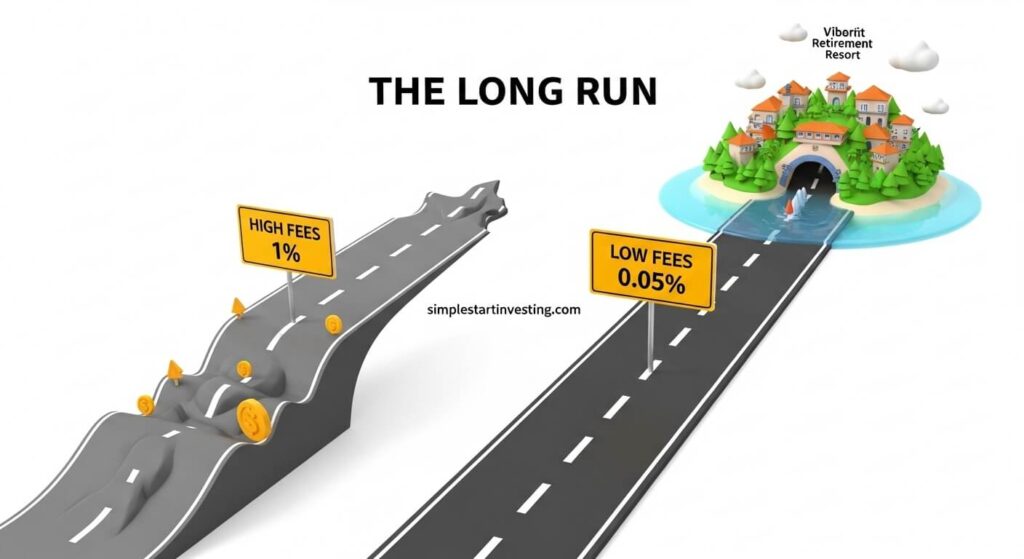
Suppose you have 100,000 dollars invested in a fund. If that fund has an expense ratio of 1%, you are paying 1,000 dollars every year.
Now, imagine you hold that fund for 30 years. You might think, “Okay, 1,000 dollars times 30 years is 30,000 dollars. That’s a lot, but I can live with it.”
But that is not how the math actually works. Because that 1,000 dollars was taken out of your account, it is no longer there to grow. In year two, you aren’t just losing the fee; you are losing the interest that the fee money would have earned.
By the end of 30 years, a 1% fee doesn’t just cost you the “sum” of the annual payments. It costs you the “compounded growth” of all those payments. In many cases, a person paying a 1% fee will end up with about 25% to 30% less money in retirement than someone paying a 0.05% fee.
To put that in perspective: if you were supposed to have 1 million dollars for retirement, a “small” 1% fee could leave you with only 700,000 dollars. That 300,000 dollar difference is the price of a house in many parts of the country.
Active vs. Passive: Where Fees Hide
When you look at your investment options, you will generally see two types of funds: Actively Managed and Passively Managed (Index Funds).
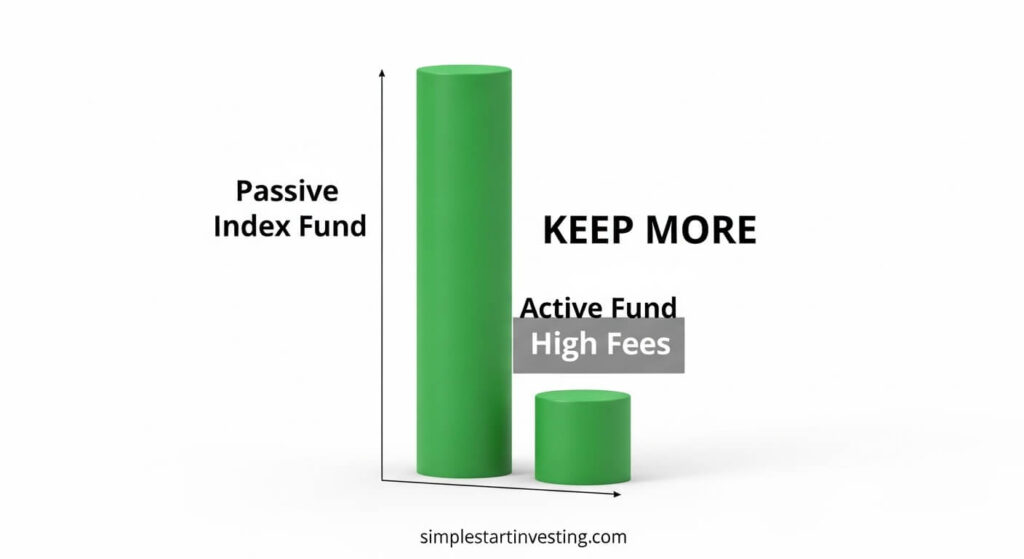
Actively Managed Funds are run by humans who try to “beat the market.” They spend a lot of money on research, high-speed data, and expensive analysts. Because their costs are high, their expense ratio is also high. It is very common to see active funds charging 0.75% to 1.5%.
Passively Managed Funds (Index Funds) don’t try to beat the market. They just try to “be” the market. For example, an S&P 500 index fund simply buys the 500 largest companies in the US. A computer can do this for almost zero cost. Because they don’t need highly paid “stock pickers,” their fees are incredibly low. You can find many index funds today with an expense ratio as low as 0.03% or even 0%.
The industry secret is that most active managers fail to beat the index funds over the long run, especially after you subtract their high fees. You are essentially paying more for a product that often performs worse.
Common Misconceptions About High Fees
One of the biggest hurdles for new investors is the “Price-Quality” bias. In almost every other area of life, you get what you pay for. A 100 dollar pair of shoes is usually better than a 20 dollar pair. A 50,000 dollar car is usually nicer than a 15,000 dollar car.
Investing is one of the only places where the less you pay, the more you get to keep.
Some people believe that a high expense ratio acts as a “premium” for better security or specialized knowledge. This is rarely true. A high fee simply means the fund company has a higher overhead or wants a higher profit margin.
Another misconception is that the fee is only charged on your gains. This is false. The fee is charged on your entire balance. Even if your investment hasn’t grown at all, the fund company still takes their cut of the principal you invested.
How to Find the Expense Ratio
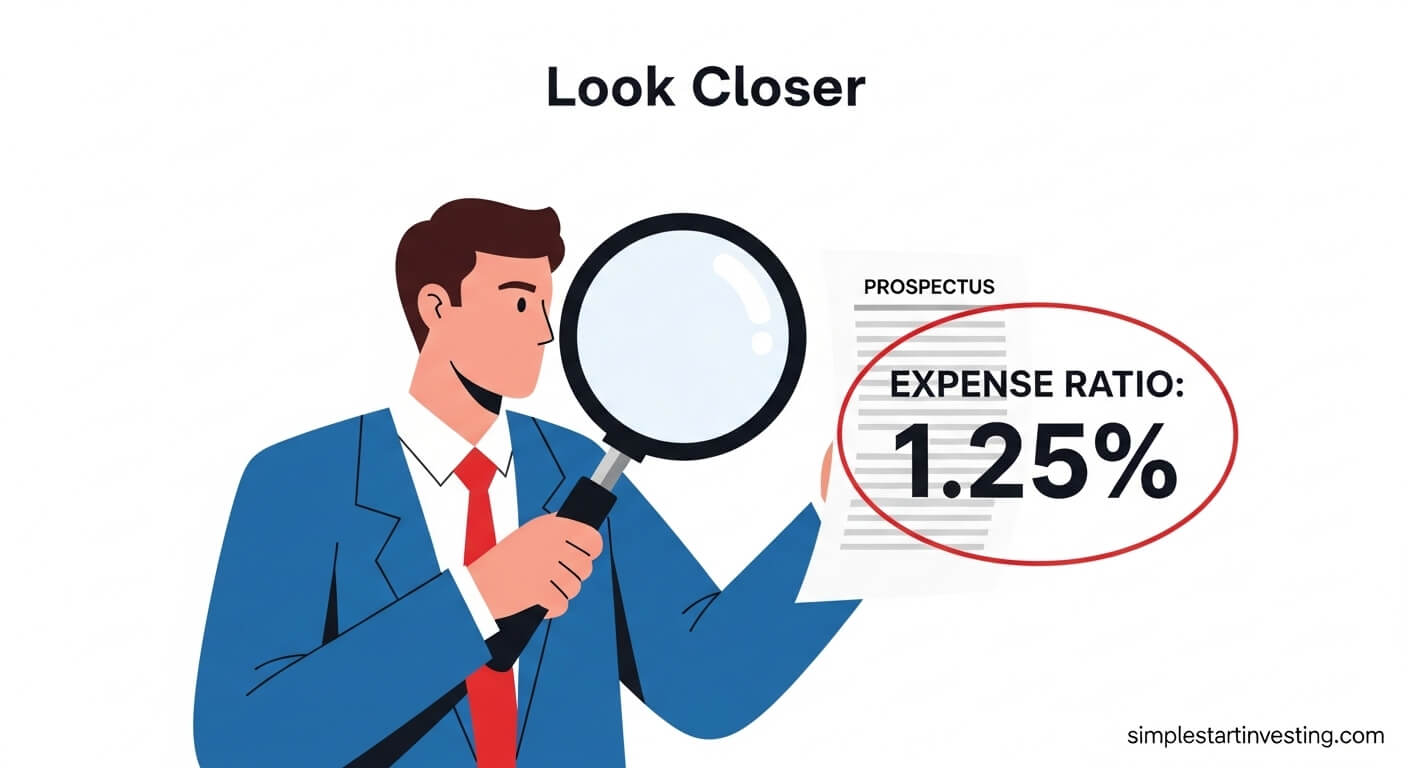
You won’t find the fee listed on the main “price” of the fund. To find it, you need to look at the fund’s prospectus or the “Summary Prospectus.” This is a legal document that every fund is required to provide.
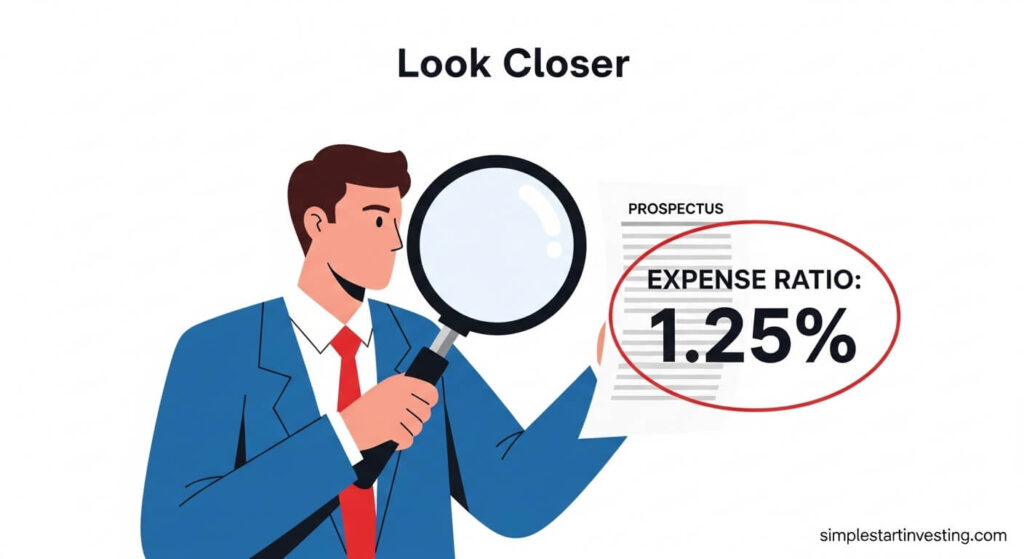
If you use a website like Yahoo Finance, Google Finance, or your brokerage’s search tool (like Fidelity, Schwab, or Vanguard), look for a section usually labeled “Fund Statistics” or “Fees.”
You are looking for a percentage. For a standard diversified stock fund, anything above 0.50% is starting to get expensive. Anything above 1% is considered very high in today’s market.
If you see two numbers, “Gross Expense Ratio” and “Net Expense Ratio,” focus on the Net Expense Ratio. This is what you are actually paying after any temporary discounts or waivers from the fund company.
The Impact on Your 401(k) and IRA
If you are an employee at a company in the US, you likely have a 401(k) plan. These plans are notorious for having “hidden” layers of fees.
In a 401(k), you are often limited to a small menu of fund choices. Some of these funds might have an expense ratio of 1.2% or higher. If your company doesn’t offer low-cost index funds, those fees are eating your retirement savings every single payday.
It is important to check the fees of every fund in your 401(k) lineup. Even if you love the idea of a “Target Date Fund” (a fund that automatically adjusts as you get older), check its cost. Some target-date funds are cheap, while others are “funds of funds” that layer multiple fees on top of each other.
The “Expense Ratio” vs. Other Costs
It is important not to confuse the expense ratio with other types of fees. While the expense ratio is the most common and often the most damaging, there are others:
- Sales Loads: These are commissions paid to a broker when you buy or sell a fund. If a fund has a “5% front-end load,” you lose 50 dollars for every 1,000 dollars you invest before you even start. Most modern investors should avoid funds with “loads” entirely.
- Transaction Costs: These are the costs the fund incurs when it buys and sells stocks inside the portfolio. These are NOT included in the expense ratio.
- Advisory Fees: If you hire a human financial advisor to manage your account, they might charge you a separate fee (often 1%) on top of the fund fees.
When you add a 1% advisor fee to a 1% fund expense ratio, you are now losing 2% of your wealth every year. If the market returns 7% and you lose 2% to fees, you are giving away nearly 30% of your annual profit to the industry.
Taking Action: What Should You Do?
You don’t need to be a math genius to optimize your portfolio. You just need to be a conscious consumer.
First, look at your current holdings. Find the expense ratio for every fund you own. If you see numbers like 0.70%, 0.90%, or 1.10%, ask yourself if there is a cheaper alternative.
For example, if you own an “Active Large Cap Growth Fund” with a 0.85% fee, look for an “S&P 500 Index Fund” or a “Total Stock Market Index Fund” with a fee of 0.05% or less. These funds often hold the same types of companies but at a fraction of the cost.
Second, don’t let the “smallness” of the number fool you. A difference between 0.10% and 0.60% seems like nothing. It’s only half a percent, right? But 0.60% is six times more expensive than 0.10%. Over a lifetime of investing, that “half a percent” can mean retiring three or four years earlier.
The Real Power of Low Fees
When you lower your expense ratio, you are essentially giving yourself a guaranteed raise. You cannot control whether the stock market goes up or down. You cannot control what the Federal Reserve does with interest rates. You cannot control the global economy.
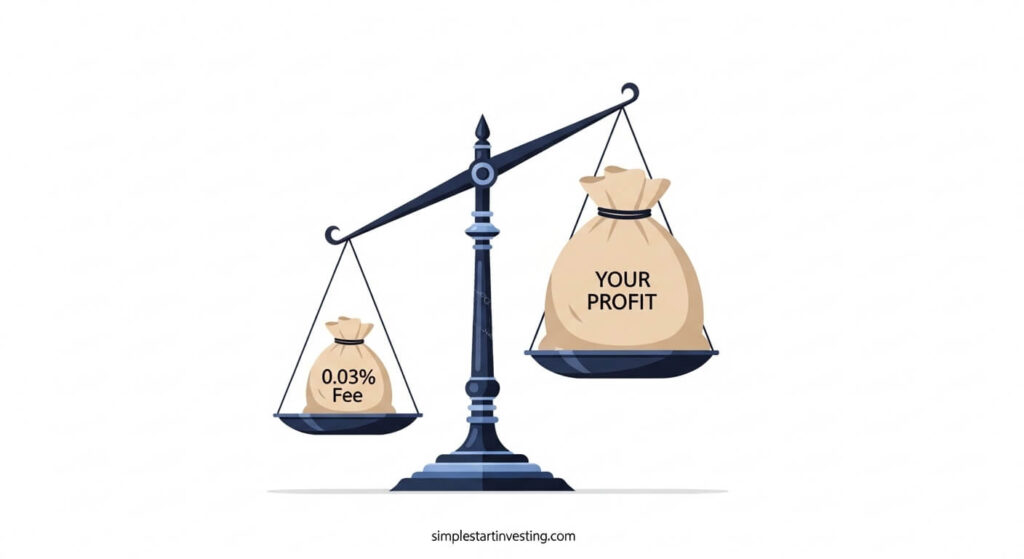
The only thing you have absolute control over in investing is how much you pay in fees.
By choosing low-cost funds, you ensure that more of your hard-earned money stays in your account, where it can compound and grow. In the long run, the person who pays the least usually ends up with the most.
Summary of Key Points for Beginners
- The expense ratio is a fee taken directly from your investment to pay for the fund’s operations.
- You never get a bill for it, which is why it is often called a “hidden fee.”
- A 1% fee sounds small but can reduce your final retirement nest egg by 25% or more over 30 years.
- Index funds almost always have much lower fees than actively managed funds.
- In investing, you don’t get what you pay for; you get what you don’t pay for.
Always take ten minutes to research the cost before you click “buy” on a new fund. Your future self—the one who wants to retire comfortably—will thank you for it.
Disclaimer: This content is for educational purposes only and does not constitute financial advice. Investment markets are subject to change and involve risk. Always perform your own due diligence or consult with a qualified professional before making financial decisions.