Did you wake up on your 50th birthday and realize your retirement nest egg looks a little smaller than you hoped? Maybe you spent your 30s paying off student loans or your 40s putting kids through college. If you feel like you are “behind” on your savings, the U.S. government actually has a special rule designed just for you.
It is called a catch-up contribution, and it is essentially a “VIP pass” that allows older workers to save more money in their retirement accounts than everyone else. This is one of the most powerful tools in the American financial system for anyone looking to make a serious impact on their future comfort in a short amount of time.
In this guide, we are going to break down exactly how these contributions work, the new “Super Catch-up” rules that just went into effect, and why this could be the most important financial move you make this year.
What Exactly Are Catch-Up Contributions?
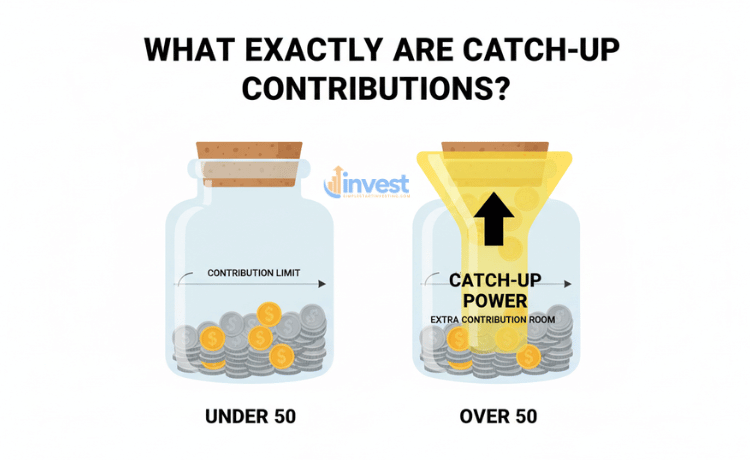
In the world of investing, the IRS (Internal Revenue Service) sets a “speed limit” on how much you can put into tax-advantaged accounts like a 401(k) or an IRA each year. For most younger workers, if they try to put in more than that limit, they face penalties.
However, once you reach the year you turn age 50, the IRS moves that speed limit sign. They allow you to “catch up” by contributing an extra chunk of money on top of the standard limit.
How it works in plain English
Imagine you are filling a bucket with water. The IRS says the bucket can only hold 20 gallons. But once you turn 50, they give you a second, smaller bucket to fill right next to the first one. This extra space is reserved specifically for people who are getting closer to retirement and need to accelerate their savings.
A real-world example
Let’s look at a typical worker named Sarah. Sarah is 52 years old and works for a company that offers a 401(k). This year, the standard limit for everyone is 23,500 dollars. Because Sarah is over 50, she is allowed to contribute an additional 7,500 dollars as a catch-up.
This means Sarah can tuck away a total of 31,000 dollars into her 401(k) this year. If she were 45, she would be stuck at the 23,500 dollar mark. That extra 7,500 dollars isn’t just “extra money”—it is money that can grow tax-deferred for another 10 or 15 years before she retires.
The common beginner mistake
Many people think they have to wait until their actual birthday to start. They believe if their birthday is in December, they can only “catch up” for that one month.
The mindset shift
You are eligible for the entire year. As long as you turn 50 at any point during the calendar year—even on December 31st—you are eligible to make the full catch-up contribution starting on January 1st of that same year. Don’t wait for the cake and candles to start saving; the IRS considers you 50 the moment the year begins.
The New “Super Catch-Up” for Ages 60 to 63
If you thought the age 50 rule was good, there is even better news for those in their early 60s. Thanks to a recent law called the SECURE Act 2.0, the government has introduced what many experts call a “Super Catch-up.”
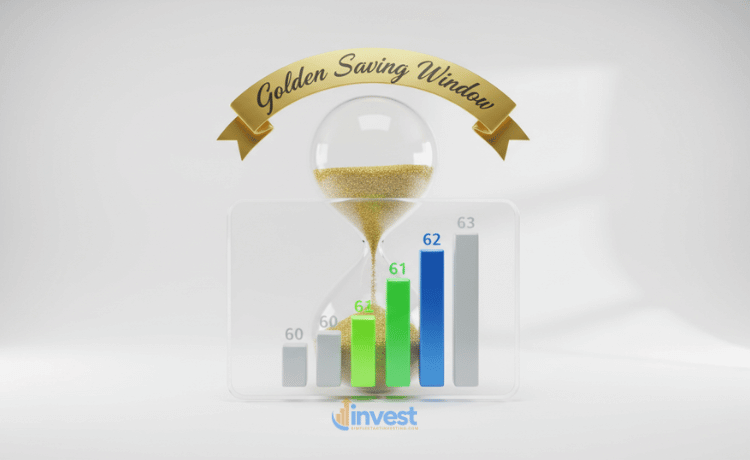
The logic is simple: the four years between age 60 and 63 are often a person’s “peak earning years.” Your house might be paid off, the kids are out of the nest, and you finally have the extra cash flow to truly maximize your retirement fund.
The logic of the Super Catch-up
For those aged 60, 61, 62, or 63, the catch-up limit increases significantly. Instead of the standard catch-up, these individuals can contribute 150 percent of the regular catch-up amount.
For example, if the normal catch-up is 7,500 dollars, a 62-year-old might be allowed to contribute 11,250 dollars instead. This allows someone at the finish line of their career to shove a massive amount of capital into the market very quickly.
A hypothetical scenario
Consider David, who is 61 and works at a major retailer like Walmart (WMT). He realized he hasn’t saved enough. Under these new rules, he can contribute the base 23,500 dollars plus his “Super Catch-up” of 11,250 dollars.
In a single year, David can move 34,750 dollars into his retirement account. If David does this for all four years (ages 60 through 63), he has added nearly 140,000 dollars to his nest egg in a very short window, not even counting any employer matching or stock market growth from companies like Apple (AAPL) or Microsoft (MSFT) that his fund might hold.
The common beginner mistake
Many people assume this “Super Catch-up” lasts forever once you hit 60.
The mindset shift
It is a specific four-year window. Once you turn 64, the “Super Catch-up” actually disappears, and you go back to the standard age-50 catch-up limit. This makes the ages of 60 to 63 a “golden window” for retirement savings. If you miss those years, you can’t get that specific extra limit back.
Catch-Up Contributions for IRAs
While 401(k) plans are through your employer, many people use an Individual Retirement Account (IRA) on their own. These also have catch-up rules, though the numbers are smaller.
For an IRA (whether it is a Traditional or a Roth IRA), the standard limit for this year is 7,000 dollars. If you are 50 or older, you can add an extra 1,000 dollars to that, bringing your total to 8,000 dollars.
Why the IRA catch-up is different
Unlike the workplace 401(k), the IRA catch-up is now “indexed for inflation.” This means every few years, the IRS might raise that 1,000 dollar limit by another 100 dollars to keep up with the rising cost of living. Starting next year, we are already seeing this limit climb to 1,100 dollars.
An everyday example
Imagine you work part-time or are a stay-at-home spouse. You don’t have a 401(k), but you have a Roth IRA. By using the catch-up provision, you are essentially giving yourself a 14 percent “bonus” in how much you can save compared to a 30-year-old. Over 15 years, that extra 1,000 dollars a year—if invested in something stable like an index fund—could grow into a significant “emergency” retirement fund.
The common beginner mistake
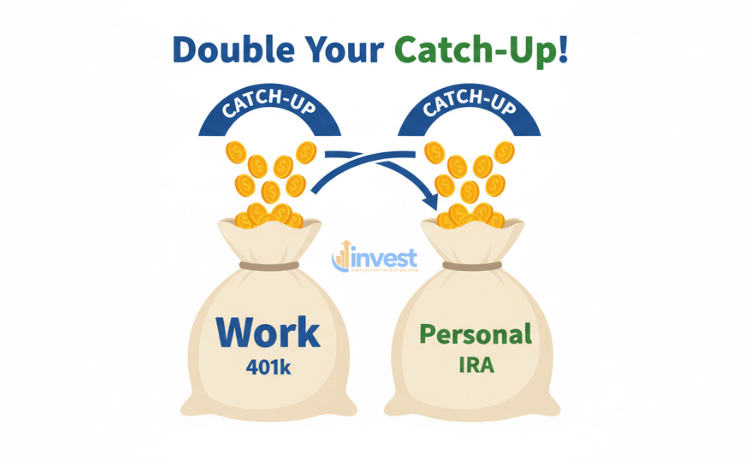
Some beginners think they have to choose between a 401(k) catch-up and an IRA catch-up.
The mindset shift
You can do both. If you have both a workplace 401(k) and a personal IRA, you can maximize the catch-up contributions in both accounts. For a 55-year-old, this could mean saving 31,000 dollars in a 401(k) and 8,000 dollars in an IRA, for a total of 39,000 dollars in a single year. That is a massive amount of tax-advantaged growth.
The “Rothification” Rule: A New Change for High Earners
There is one “catch” to these catch-up contributions that you need to be aware of, especially if you have a high income. It is a new rule that began recently, often called Rothification.

What this means for your taxes
Historically, most people made catch-up contributions “pre-tax,” meaning the money came out of their paycheck before taxes were taken out. This lowered their tax bill today.
However, the IRS now says that if you earned more than 145,000 dollars in the previous year (this number is indexed, so it may be closer to 150,000 dollars now), your catch-up contributions must be made into a Roth account.
How it works simply
- If you earn less than the threshold: You can choose to have your catch-up be pre-tax (save on taxes now) or Roth (save on taxes later).
- If you earn more than the threshold: The government forces you to use the Roth option. You pay taxes on the money now, but that money—and all its growth—is 100 percent tax-free when you take it out in retirement.
Real-world example
Let’s say Maria is a manager at a large tech company like Amazon (AMZN) and makes 160,000 dollars a year. When she tries to make her 7,500 dollar catch-up contribution, her employer’s payroll system will automatically designate it as “Roth.” She won’t get a tax deduction for that 7,500 dollars this year, but when she retires at 70, every penny of that 7,500 dollars (and whatever it grew into) will be hers to keep without giving a cent to the IRS.
The common beginner mistake
High earners often panic and think they can’t do catch-up contributions anymore if their plan doesn’t offer a Roth option.
The mindset shift
Check with your HR department. If a company has high-earning employees and wants to allow catch-up contributions, they must offer a Roth 401(k) option. Most major U.S. employers have already updated their plans to accommodate this. If yours hasn’t, it is worth a conversation with your benefits coordinator.
Don’t Forget the HSA: The “Triple Tax Threat”
Many people forget that the Health Savings Account (HSA) also has a catch-up provision. While the other accounts use age 50 as the magic number, the HSA uses age 55.

The power of the HSA catch-up
An HSA is arguably the best investment account in America because it is “triple tax-advantaged”:
- The money goes in tax-free.
- It grows tax-free.
- You take it out tax-free for medical expenses.
Once you turn 55, the IRS allows you to contribute an extra 1,000 dollars per year to your HSA.
An everyday example
If you are 56 years old and have a family high-deductible health plan, the standard limit might be 8,550 dollars. With your catch-up, you can put in 9,550 dollars. Since healthcare is often the biggest expense in retirement, using this catch-up to build a “health nest egg” is a brilliant move. You could use this money to pay for anything from dental work to Medicare premiums in the future.
The common beginner mistake
People think HSA money is “use it or lose it” like an FSA.
The mindset shift
HSAs are forever. Unlike an FSA at work, the money in an HSA rolls over every year. You can invest that 1,000 dollar catch-up in stocks like Johnson & Johnson (JNJ) or Pfizer (PFE) and let it grow for decades. It is essentially a second retirement account hidden inside a health plan.
Why “Catching Up” is Better Than Starting Late
Some people feel discouraged. They think, “What is an extra 7,500 dollars going to do when I need a million to retire?”
The answer lies in the math of compounding. Even if you are 50, you likely have 15 to 20 years before you stop working.
The logic of the “Extra Mile”
If you contribute just the catch-up amount of 7,500 dollars every year for 15 years, you have put in 112,500 dollars of your own money. If that money grows at a modest rate—let’s say it doubles every 10 years—that “small” extra contribution could turn into 200,000 or 250,000 dollars by the time you are 65.
That is the difference between a retirement where you are stressed about the grocery bill and a retirement where you can afford to travel and see the grandkids.
A real-world example
Take Robert, age 50. He already maxes out his 401(k) at 23,500 dollars. He decides to “find” the extra 7,500 dollars for the catch-up by cutting back on eating out and a luxury car lease. Over the next 15 years, Robert’s “sacrifice” of that 7,500 dollars a year could realistically provide him with an extra 1,000 dollars a month in retirement income for the rest of his life.
The common beginner mistake
Waiting for a “perfect time” when you have extra cash to start the catch-up.
The mindset shift
Automate the increase. You don’t have to do the full 7,500 dollars at once. You can go into your payroll portal and increase your contribution by just 1 or 2 percent. You will barely notice the difference in your take-home pay because of the tax savings, but your “future self” will definitely notice the difference in your account balance.
Steps to Take Right Now
If you are over 50 (or turning 50 this year), here is your checklist to get started:
- Log into your workplace 401(k) portal. Look for the “Contribution” section. Most modern systems will have a specific button or checkbox that says “Maximize Catch-up Contributions.”
- Check your age for the “Super Catch-up.” If you are between 60 and 63, verify if your employer has adopted the new SECURE 2.0 limits. This could allow you to save over 11,000 dollars extra.
- Review your income. If you make over 145,000 dollars, make sure you are prepared for those catch-up dollars to go into a Roth account.
- Open an IRA if you don’t have one. Even if you have a 401(k) at work, you can still use an IRA to grab that extra 1,000 dollar catch-up (depending on your income levels).
- Don’t forget the HSA. If you are 55 or older, log into your health savings portal and add that extra 1,000 dollars.
Final Thoughts: It’s Never Too Late
The biggest myth in finance is that if you didn’t start at 22, you’ve already lost. The U.S. tax code is actually quite forgiving to those who start late—as long as they are willing to take action once they hit that 50-year milestone.
Catch-up contributions are the government’s way of saying, “We know life happens, and we want to help you cross the finish line.” Whether you are 50, 60, or 63, these extra limits are yours for the taking. Don’t leave that money on the table.
Disclaimer: This content is for educational purposes only and does not constitute financial, tax, or legal advice. Rules and limits set by the IRS can change annually; please consult with a qualified financial advisor or tax professional regarding your specific situation.